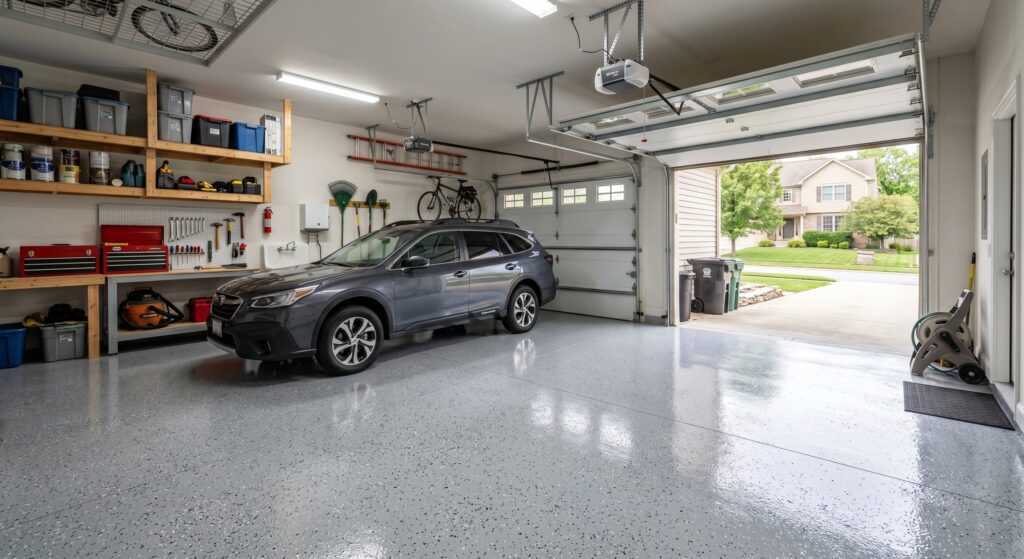
Garage floors take a beating. Between oil drips, tire scuffs, cracking slabs, and moisture pushing up from below, an uncoated concrete floor deteriorates faster than most homeowners expect. Once the surface starts breaking down, loose concrete dusts everything in the space and cleaning becomes a losing battle.
That is where epoxy garage floor paint changes the situation. A properly installed epoxy coating bonds directly to the concrete, sealing the surface against chemicals, moisture, and abrasion. It transforms a worn slab into a clean, durable floor that is far easier to maintain.
At Old Stone Restoration & Installation Corp, we have over 35 years of experience installing epoxy flooring systems for residential, commercial, and industrial properties across Long Island and the greater New York area. Through decades of hands-on work, our team has tested numerous coating systems and understands which products perform best in real-world environments. This guide covers the five best garage floor epoxy paints available in 2026, what separates them, and when a professional installation makes more sense than a store-bought kit.
Why Garage Floors Fail
Concrete is strong under compression but porous. Without a protective coating, several forces attack the surface over time:
- Oil and gasoline stains penetrate deep into the concrete, leaving permanent discoloration and weakening the surface layer.
- Hot tire marks transfer chemicals from rubber compound onto the floor, leaving sticky residue that lifts paint from poorly bonded coatings.
- Hairline cracks develop from freeze-thaw cycles and slab settlement, allowing moisture to enter and widen the damage.
- Moisture vapor rising through the slab pushes coatings up from underneath, causing bubbling and delamination that no topcoat can fix without proper prep.
Epoxy coatings address all of these problems when installed correctly. The key word is correct. Surface preparation determines whether an epoxy system lasts 15 years or peels within 18 months.
Quick Comparison Table of the Best Garage Floor Epoxy Paints
| Brand | Best For | Durability | DIY Friendly | Professional Grade |
|---|---|---|---|---|
| Rust-Oleum EpoxyShield | Home Garages | 4/5 | Yes | No |
Rust-Oleum RockSolid Polycuramine | Heavy Use | 5/5 | Yes | Semi-Pro |
| ArmorPoxy | Commercial Use | 5/5 | Moderate | Yes |
Epoxy-Coat | DIY Projects | 4/5 | Yes | No |
| Colored Epoxies 100% Solids | Professional Installations | 5/5 | No | Yes |
What Makes a Good Garage Floor Epoxy Paint?
Epoxy is a family of thermosetting polymers formed by reacting a resin with a hardening agent. When the two components cure, they cross-link into a tough, chemically resistant film that bonds tightly to concrete. For more on the underlying chemistry, the Wikipedia article on epoxy provides a thorough overview. Not every product marketed as garage floor epoxy performs the same. When evaluating options, these five characteristics matter most.
Chemical Resistance
A quality epoxy coating resists oil, gasoline, and brake fluid without softening or staining. Floors in active garages will contact all three. Products with lower solids content tend to absorb these chemicals over time, leading to discoloration and surface breakdown.
Hot Tire Resistance
Standard latex floor paints fail under hot tires because the rubber compound chemically bonds to the coating as it cools. True epoxy systems cure into a harder film that resists this transfer. Polycuramine and 100% solid epoxy systems offer the strongest performance in this category.
Abrasion Resistance
Daily foot traffic, rolling toolboxes, and vehicle tires all wear the surface. Measured by mil thickness after cure, higher solids content coatings leave a thicker protective film and outlast thin-build products by years.
UV Stability
Garages with windows or open doors expose floors to sunlight. Standard epoxy yellows under UV exposure. Products with added UV stabilizers or urethane topcoats hold their color significantly longer. Beyond color stability, coating formulations are also subject to federal VOC content limits. The EPA’s National Volatile Organic Compound Emission Standards for Architectural Coatings sets maximum VOC limits for products in this category. When comparing epoxy paints, lower VOC formulations are better for indoor air quality and comply with these federal standards.
Ease of Application
Two-part epoxy systems require mixing resin and hardener in the correct ratio and working within an open time that shortens in warm weather. Some DIY kits simplify this process with premeasured components, though they generally trade performance for convenience.
5 Best Epoxy Paints for Garage Floors
1. Rust-Oleum EpoxyShield Garage Floor Coating
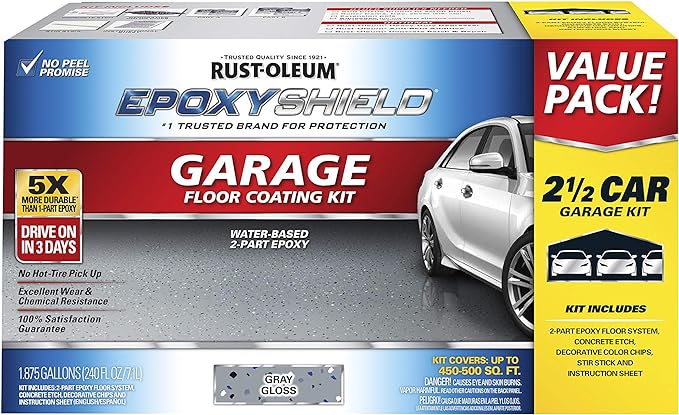
Rust-Oleum EpoxyShield is one of the most widely used garage floor coating products in the DIY market. It is a water-based two-part epoxy system designed for residential garages and sold at most home improvement retailers.
Pros:
- Widely available and competitively priced
- Straightforward two-part mixing process suitable for first-time applicators
- Decent resistance to oil stains and mild chemicals
- Decorative chip flakes included in many kit versions
Cons:
- Water-based formula results in lower solids content than professional systems
- Hot tire lifting is a known limitation without a urethane topcoat
- Requires very clean, profiled concrete to bond properly
- Lifespan of 5 to 10 years under moderate use
Best For: Homeowners with lightly used single-car garages who want a clean appearance on a limited budget.
Expert Rating: 3.5 out of 5. A solid entry-level product for the right application. It will not hold up in a high-use shop environment.
2. Rust-Oleum RockSolid Polycuramine Floor Coating
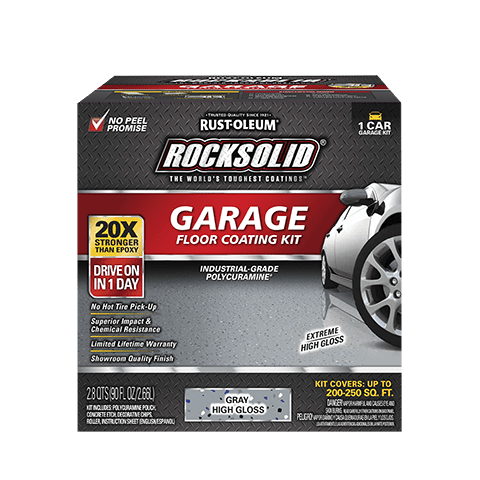
RockSolid uses Polycuramine technology rather than standard epoxy chemistry. Rust-Oleum markets it as 20 times stronger than conventional epoxy, with strong resistance to hot tires, oil, salt, and chemicals. The roll-and-go application process is simpler than traditional two-part epoxy mixing.
Pros:
- Superior hot tire resistance compared to standard water-based epoxy
- Easier application with the roll-and-go process
- Resists salt and road chemicals, particularly useful in northern climates
- Attractive semi-gloss finish with good color retention
Cons:
- Higher price point than EpoxyShield
- Still requires thorough surface etching and cleaning before application
- Thinner build than 100% solids professional systems
Best For: Homeowners who want better-than-basic performance without hiring a contractor. Also works well for two-car garages with regular vehicle traffic.
Expert Rating: 4 out of 5. The Polycuramine chemistry offers a real performance upgrade over standard DIY epoxy kits.
3. ArmorPoxy Garage Floor Kit
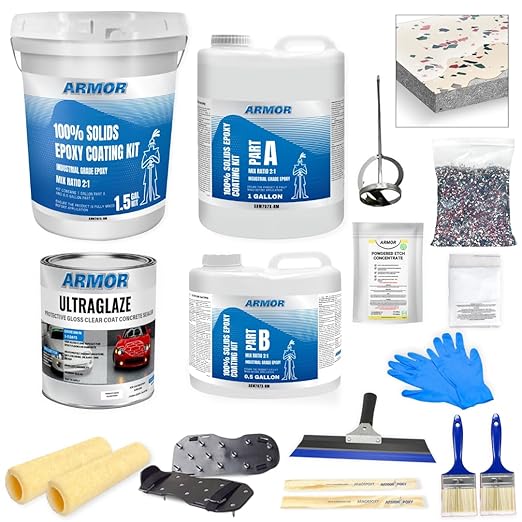
ArmorPoxy produces a 100% solid epoxy system marketed toward both homeowners and commercial users. The product line includes high-build base coats and multiple topcoat options, giving applicators more control over the final system.
Pros:
- High solids content produces a thicker, more durable film
- Multiple system configurations available for different environments
- Strong chemical and abrasion resistance
- Longer expected lifespan than consumer-grade kits, ranging from 10 to 20 years
Cons:
- Mixing ratios and application require more experience than basic kits
- Higher upfront cost
- Surface preparation requirements are stricter than water-based products
Best For: Commercial garages, workshops, and property owners who want a longer-lasting system and are comfortable with a more involved application process.
Expert Rating: 4.5 out of 5. A strong commercial-grade option for those willing to invest in proper prep and application.
4. Epoxy-Coat Professional Floor Coating
Epoxy-Coat offers a 100% solid two-part system with a straightforward ratio and a strong focus on the DIY market. The brand includes detailed instructions and customer support, lowering the learning curve for first-time users tackling a higher-performance product.
Pros:
- 100% solids formula for better build and durability than water-based alternatives
- Clear instructions and available technical support
- Wide range of colors and decorative chip options
- Good value for the solids content
Cons:
- Still requires proper mechanical surface preparation for best adhesion
- Open time is shorter in warm weather, requiring efficient application
- Not intended for industrial or heavy forklift environments
Best For: Ambitious DIYers who want a professional-quality finish without hiring a contractor. Works well for residential garages and light commercial spaces.
Expert Rating: 4 out of 5. A well-balanced product that bridges the gap between consumer kits and professional systems.
5. Colored Epoxies 100% Solids Epoxy
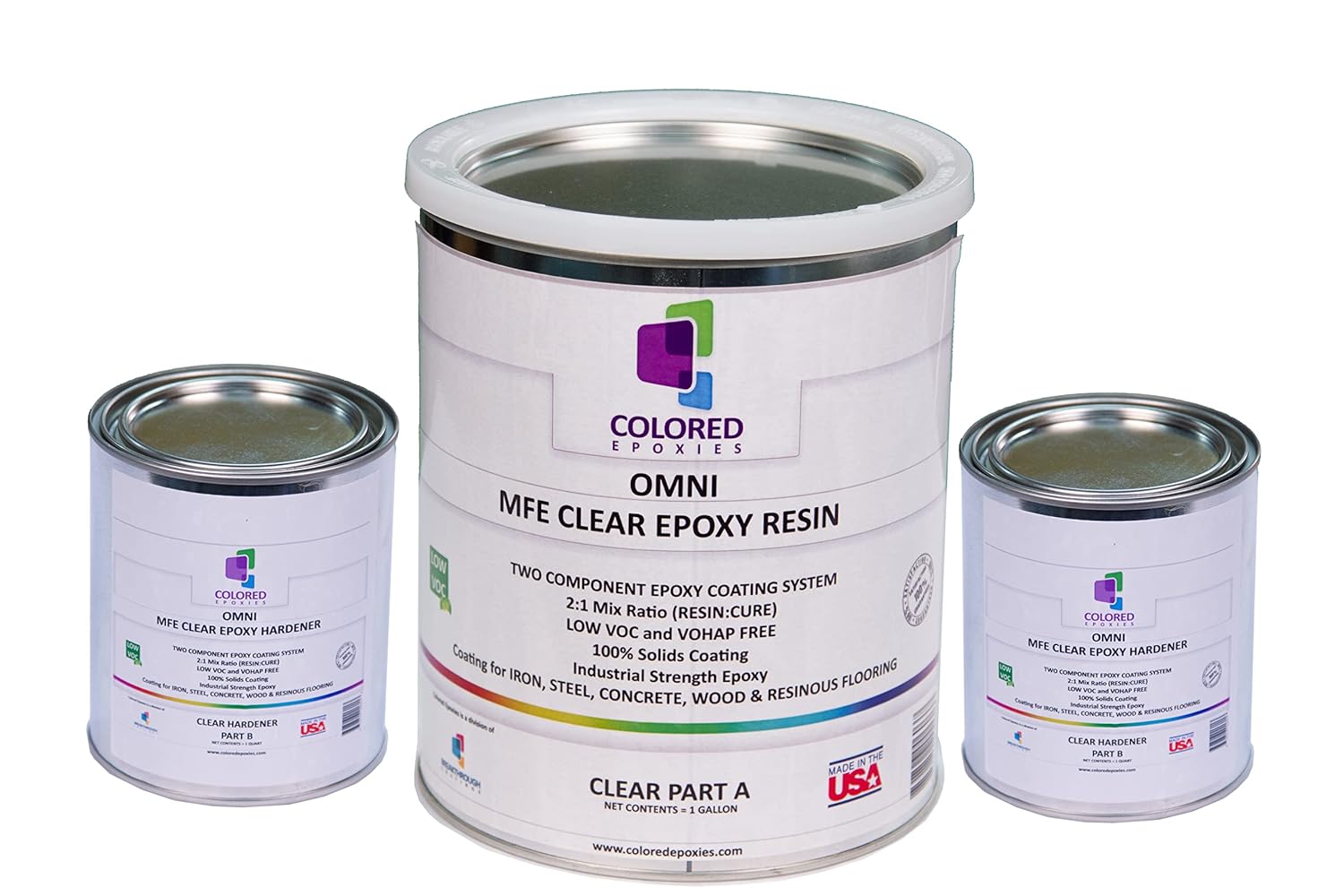
Colored Epoxies offers one of the highest-performance consumer-accessible 100% solids epoxy systems on the market. With minimal volatile organic compounds, a very high build, and exceptional durability, this product is used by professional epoxy floor contractors and serious DIYers alike.
Pros:
- True 100% solids formula with the thickest film build of any product in this comparison
- Outstanding chemical, abrasion, and impact resistance
- Expected lifespan of 15 to 20 or more years with proper installation
- Suitable for industrial and commercial environments beyond the garage
Cons:
- Not recommended for inexperienced applicators without professional guidance
- Requires diamond grinding or shot blasting for proper adhesion
- Higher cost than all other options in this comparison
Best For: Professional installations, commercial properties, and high-use garages where a long-term investment makes sense.
Expert Rating: 5 out of 5. The top-performing product in this comparison. When installed by an experienced epoxy floor contractor, this system delivers the longest service life available.
Which Garage Floor Epoxy Paint Lasts the Longest?
| Product | Expected Lifespan |
|---|---|
| Rust-Oleum EpoxyShield | 5 to 10 Years |
| Rust-Oleum RockSolid Polycuramine | 10 to 15 Years |
| ArmorPoxy | 10 to 20 Years |
| Epoxy-Coat | 8 to 15 Years |
| Colored Epoxies 100% Solids | 15 to 20+ Years |
Lifespan depends heavily on surface preparation, application quality, and the intensity of use. A professionally installed 100% solids system in a commercial setting will consistently outperform any DIY kit, regardless of brand.
DIY Garage Floor Epoxy vs Professional Installation
DIY Advantages
- Lower upfront cost when labor is excluded
- Control over scheduling and product selection
- Suitable for small, lightly used residential garages
- Several quality products available at home improvement retailers
DIY Limitations
Most failed garage floor epoxy jobs trace back to four factors, none of which are related to the paint itself.
- Surface preparation: Acid etching, the most common DIY prep method, does not open concrete pores sufficiently for high-performance adhesion. Mechanical grinding is far more effective.
- Moisture testing: Applying epoxy over concrete with elevated moisture vapor transmission leads to delamination. Testing requires specialized equipment most homeowners do not own.
- Crack repair: Active cracks need to be filled and stabilized before coating. Coating over an active crack without treatment allows the crack to telegraph through the epoxy layer.
- Improper curing: Temperature and humidity affect cure time significantly. Many DIY failures occur when coatings are applied outside the manufacturer’s specified conditions.
Why Surface Preparation Matters More Than the Paint
The coating product accounts for less than half of the outcome on any epoxy flooring project. Surface preparation is the determining factor.
Professional installations begin with diamond grinding or shot blasting to mechanically open the concrete profile. This creates the anchor pattern needed for a permanent bond between the epoxy system and the substrate. Acid etching, the standard DIY recommendation, cannot replicate this profile consistently.
Before any coating is applied, moisture vapor transmission testing is performed. Concrete slabs in contact with soil release moisture vapor continuously. If the vapor transmission rate exceeds the coating system’s tolerance, the floor will fail regardless of how good the product is.
Crack repair precedes coating work on any floor with visible damage. Surface cracks must be routed, cleaned, and filled with an appropriate repair compound before the base coat is applied. For a deeper look at this process, see our guide on concrete crack repair.
When Epoxy Paint Is Not Enough
Standard epoxy floor paint is designed for moderate use environments. Certain applications require a more robust solution.
Food processing facilities, manufacturing plants, commercial kitchens, and areas with heavy forklift traffic need a coating system that handles thermal shock, heavy impact, and aggressive chemical exposure. Epoxy paint systems are not rated for these environments.
Epoxy urethane mortar systems fill this gap. These trowel-applied systems are significantly thicker than painted coatings, bond directly to damaged or contaminated concrete, and withstand conditions that would destroy a standard epoxy paint coating within months. They are the preferred solution for industrial floors, loading docks, and any environment where floor failure creates a safety or operational risk.
Old Stone Restoration & Installation Corp installs epoxy urethane mortar systems for commercial and industrial clients throughout Long Island and the New York metro area. These systems are specified when performance requirements exceed what any painted coating can deliver.
Professional Epoxy Flooring Services vs Store-Bought Kits
Store-bought epoxy kits are a reasonable option for residential garages with light to moderate use. A homeowner willing to follow surface preparation steps carefully and work within the manufacturer’s guidelines can achieve a functional result.
Commercial and industrial environments are a different matter. High-traffic floors, chemical exposure, forklift loads, and thermal cycling demand professional-grade epoxy flooring systems installed by experienced contractors. The economics also shift at scale. A professional installation on a commercial floor costs more upfront but requires far fewer repairs and no recoating cycles over the same period that a store-bought kit would need two or three applications.
Residential garage floors that have existing moisture issues, significant cracking, or previous coating failures benefit from professional assessment before any product is applied. Applying a new coating over a floor with unresolved problems produces the same outcome as the previous attempt.
Why Property Owners Choose Old Stone Restoration & Installation Corp
Old Stone Restoration & Installation Corp has provided professional epoxy flooring services across Long Island for over 35 years. The company serves residential, commercial, and industrial clients, with the full range of coating systems needed to match the right solution to each environment.
- 35 years of industry experience across residential, commercial, and industrial properties
- Certified surface preparation specialists using diamond grinding and shot blasting equipment
- Moisture vapor testing performed on every project before coating begins
- High-performance coating systems including 100% solids epoxy, epoxy urethane mortars, and decorative broadcast systems
- Long-term durability focus, with installations specified to minimize lifetime maintenance costs
Every project starts with an honest assessment of the floor’s condition. The recommendation reflects what the floor actually needs, not what is easiest or least expensive to install.
FAQs
What is the best epoxy paint for a garage floor?
For DIY residential applications, Rust-Oleum RockSolid Polycuramine offers the best balance of performance and ease of application. For professional installations, Colored Epoxies 100% Solids or a comparable commercial system delivers the longest service life.
Conclusion
The right garage floor epoxy coating depends on the specific environment and performance requirements.
Category | Recommended Product |
|---|---|
| Best Overall | Rust-Oleum RockSolid Polycuramine |
Best Budget Option | Rust-Oleum EpoxyShield |
| Best Professional Grade | Colored Epoxies 100% Solids |
Best Commercial Option | ArmorPoxy |
| Best DIY Choice | Epoxy-Coat |
For most residential garages, RockSolid Polycuramine offers one of the best combinations of durability and DIY accessibility. For commercial properties, industrial spaces, or any floor with pre-existing problems, a professionally installed 100% solids system is the better long-term investment.
Old Stone Restoration & Installation Corp serves property owners across Long Island and the New York metro area. Whether the project is a residential garage, a commercial showroom, or an industrial facility, the team brings 35 years of experience and the equipment needed to prepare the floor correctly and install a coating system built to last.
Contact us at (631) 821-5619 to request a consultation. For projects requiring industrial-strength floor systems, learn more about our epoxy urethane mortar services below.
FAQs
Is Rust-Oleum epoxy floor paint worth it?
Rust-Oleum products work well for lightly used residential garages when surface preparation is done correctly. EpoxyShield is the more affordable option for basic protection. RockSolid Polycuramine is worth the additional cost for garages with regular vehicle traffic.
How long does garage floor epoxy last?
DIY water-based epoxy systems typically last 5 to 10 years. High-solids professional systems installed with proper surface preparation last 15 to 20 or more years.
Can epoxy be applied over cracked concrete?
Minor surface cracks can be repaired before coating. Active structural cracks need to be evaluated and stabilized first. Applying epoxy over an active crack without treatment will result in the crack reappearing through the coating.
Is professional epoxy flooring better than DIY kits?
For commercial, industrial, and high-use residential floors, professional installation consistently outperforms store-bought kits. The difference comes from mechanical surface preparation, moisture testing, and the use of higher-solids coating systems.
How much does epoxy flooring cost?
DIY kits for a standard two-car garage range from $100 to $500 depending on the product and coverage area. Professional epoxy flooring installation for a residential garage generally ranges from $3 to $12 per square foot depending on the system, surface condition, and prep required.
What is the difference between epoxy and epoxy urethane mortar?
Standard epoxy floor paint is applied by roller and cured into a thin protective film. Epoxy urethane mortar is a trowel-applied system with far greater thickness and compressive strength. Mortar systems are used in industrial and commercial environments where painted coatings cannot meet the performance requirements.