A high-quality epoxy garage floor can last for years, but only if it’s finished with the right sealer. The topcoat you choose directly impacts durability, gloss, chemical resistance, and how well your floor holds up under daily wear. That’s why understanding what kind of sealer to use on an epoxy garage floor is essential before starting any project. In this guide, we break down the best options, how they work, and how to choose the right system for long-term performance.
What Is an Epoxy Garage Floor?
An epoxy floor coating is a resin-based system that bonds to prepared concrete and creates a hard, protective surface. Compared with standard floor paint, epoxy offers stronger adhesion, better impact resistance, and improved protection from chemicals, stains, and abrasion. Epoxy flooring is widely used because of its durability, adhesive strength, and easy maintenance.
For homeowners comparing systems, epoxy flooring for garage spaces is often chosen because it delivers both function and appearance. Old Stone Restoration & Installation Corp offers garage floor systems that are built for heavy use, chemical resistance, anti-skid options, and customizable finishes such as metallic, chip, quartz, and solid color systems. We also provide heavier-duty systems like epoxy and urethane mortars for demanding environments.
Why You Should Use a Sealer on Epoxy Floors
A sealer or topcoat is not just about extra shine. It is there to add another layer of garage floor protection. Depending on the product, a topcoat can improve scratch resistance, UV stability, chemical resistance, stain resistance, and ease of cleaning. Concrete Network explains that floor sealers can protect surfaces from abrasions and stains while also improving appearance.
Another reason sealers matter is moisture. Moisture vapor transmission through the slab can push upward and cause blistering, disbondment, or loss of adhesion in resinous flooring systems. Sherwin-Williams specifically warns that moisture vapor can damage coatings and that a properly selected moisture vapor barrier or mitigation layer can help prevent those failures.
Types of Sealers and Topcoats for Epoxy Garage Floors
Epoxy Topcoat
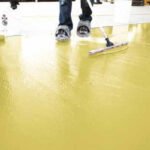
A clear epoxy topcoat is one of the most common options used over decorative garage coatings. It can add gloss, deepen color, and improve chemical and wear resistance. Rust-Oleum describes its premium clear garage floor coating as a durable, impact-resistant, high-gloss epoxy finish used over bare or coated concrete floors. For indoor garages where UV exposure is limited, a clear epoxy layer can be a strong choice.
Polyurea or Polyaspartic Clear Coat
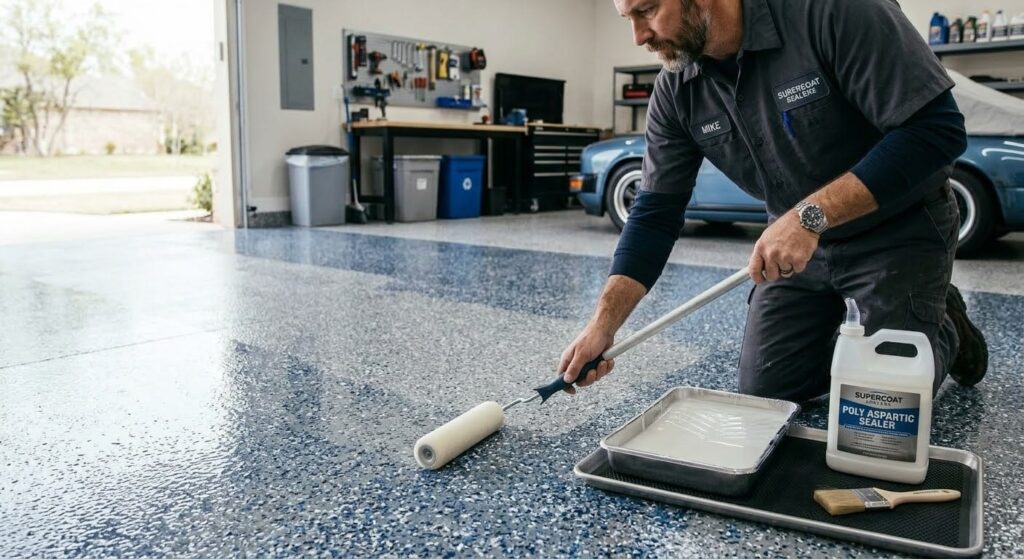
If your garage gets sunlight or you want a faster return to service, a polyurea topcoat or polyaspartic clear coat is often the better choice. Polyurea and polyaspartic systems are excellent when quick return to service matters, and it specifically recommends a UV-resistant polyaspartic topcoat when the garage floor is exposed to direct sunlight. Polyaspartic topcoats are often used to reduce yellowing and provide extra protection over the base system.
Penetrating Concrete Sealer
A penetrating concrete sealer is different from a film-forming topcoat. It is usually used on bare concrete, not as the visible finish layer over epoxy. Penetrating sealers are designed to move into the concrete and protect against moisture intrusion while keeping a natural look.
They are commonly used where invisible protection is desired and are especially valuable against moisture and freeze-thaw exposure. In some projects, moisture-mitigation products or penetrating prep systems are used before the epoxy system to improve long-term performance.
Avoid Incompatible Sealers
Not every garage floor sealer works under or over epoxy. Some existing sealers can interfere with bonding, and certain water-repellent or incompatible products can lead to adhesion problems. Improper substrate preparation is a leading cause of coating failure, so it’s important to check for moisture or prior sealers before coating concrete.
How to Choose the Best Sealer for Epoxy Flooring for Garage
When deciding on the best epoxy sealer for garage use, focus on five things:
- Compatibility with epoxy: The topcoat has to be designed to work with the underlying epoxy system. Poor compatibility can lead to peeling or delamination.
- Abrasion and impact resistance: Garages deal with tires, dropped tools, and foot traffic.
- UV and chemical resistance: If sunlight reaches the floor, a polyaspartic topcoat is usually stronger than a standard epoxy clear coat for UV stability.
- Moisture management: If the slab has moisture issues, you may need a primer or moisture vapor barrier below the system.
- Finish and slip resistance: Gloss, satin, and textured finishes all affect maintenance and safety. Some systems can also include anti-slip additives. We offer anti-skid options for garage floors.
A Quick Comparison
| Sealer Type | Finish & Appearance | Key Benefits | Best Use Case | Limitations |
| Epoxy Clear Topcoat | High-gloss, smooth | Durable, strong chemical resistance, enhances color | Indoor garages with low UV exposure | Can yellow over time with sunlight |
| Polyurea / Polyaspartic Topcoat | Gloss to satin options | Fast curing, excellent UV resistance, highly durable | Active garages, areas with sunlight exposure | Higher cost, requires precise application |
| Penetrating Sealer | Natural / invisible finish | Protects against moisture, improves adhesion | Concrete prep or moisture-prone slabs | Not a decorative top layer over epoxy |
Step-by-Step Sealer Application Tips
A durable system starts with surface preparation. Our installation process includes site evaluation, moisture checks, diamond grinding or shot blasting, concrete repair, primer application, system installation, and topcoat application. That process aligns with wider industry best practices.
A basic sequence looks like this:
- Clean and degrease the floor thoroughly.
- Test for moisture and existing sealers.
- Diamond grind or mechanically prep the slab.
- Repair cracks, pits, and damaged areas.
- Apply primer or moisture-control layer if needed.
- Install the epoxy floor coating.
- Finish with the right epoxy topcoat or polyurea/polyaspartic clear coat.
- Add anti-slip media if safety is a concern.
- Respect cure times before foot or vehicle traffic.
Common Mistakes to Avoid
The biggest mistake is skipping moisture testing. Moisture vapor is one of the leading causes of coating failure. Another common issue is coating over dirty concrete, old sealers, or poorly prepared surfaces. In fact, improper surface preparation is a top reason epoxy floors fail. Using the wrong product on the wrong system is another avoidable mistake.
Maintenance Tips After Sealing
Once your floor is sealed, maintenance is simple but important. Regular sweeping and mopping with a mild or pH-neutral cleaner usually keeps epoxy floors looking good. We give similar care guidance for our epoxy and urethane mortar systems, advising regular cleaning and caution with abrasive cleaners. If the finish starts losing gloss, showing scratches, or wearing through in traffic paths, it may be time to consider recoating.
DIY vs. Professional Installation
A small garage and a straightforward concrete slab may be manageable for a skilled DIY installer, but long-term performance depends heavily on prep, moisture testing, and product compatibility. Professional installation reduces the risk of adhesion problems and coating failure. Old Stone Restoration & Installation Corp provides garage floor systems built for durability, anti-skid safety, and fast return to use, along with specialty epoxy and urethane mortar systems for tougher environments.
Conclusion
The best answer to “what kind of sealer to use on epoxy garage floor” depends on the floor’s exposure, moisture conditions, and performance needs. A clear epoxy topcoat can work well for indoor decorative floors. A polyurea or polyaspartic topcoat is often better where UV resistance and faster cure matter. If moisture is a concern, a proper moisture vapor barrier or mitigation layer may be essential before the coating system ever goes down.
For professionally installed epoxy flooring for garage spaces and more advanced resin systems, Old Stone Restoration & Installation Corp offers garage floor solutions as well as epoxy and urethane mortar systems tailored to demanding conditions. Call us at (631) 821-5619 to discuss your needs.
FAQs
Can you put a sealer over epoxy garage floor?
Yes. Many systems use a clear topcoat over epoxy for added protection, gloss, UV resistance, or easier cleaning, but the topcoat must be compatible with the epoxy underneath.
What is the difference between a sealer and a topcoat?
A sealer is a broad term. A topcoat usually refers to the final protective finish layer over the system. A penetrating sealer, by contrast, is usually used within or before the system on concrete rather than as the visible decorative finish.
How long does epoxy sealer last on a garage floor?
It depends on traffic, prep quality, and the product used. In general, professionally installed systems last longer because the surface preparation and product selection are better controlled.
Is penetrating sealer needed before epoxy?
Not always. But if the slab has moisture-related concerns, a moisture-control or mitigation layer may be needed before the epoxy system to reduce the risk of blistering and adhesion failure.