Choosing an epoxy flooring contractor can be difficult when several companies seem to offer similar services. The real difference often comes down to how the concrete is prepared, which flooring system is used, and how the work is handled.
A floor may look great when the job is finished but develop peeling, bubbling, or other problems later if important steps are missed. Asking the right questions before hiring a contractor can help avoid these issues.
Old Stone Restoration and Installation Corp. brings over 35 years of experience restoring and protecting concrete and stone surfaces. That background allows the team to assess different flooring conditions and recommend a system based on how the space will actually be used.
For anyone unsure what to ask before hiring an epoxy contractor, the questions below focus on the areas that matter most, including concrete preparation, moisture testing, epoxy systems, installation, warranties, and future repairs.
Quick Answer:
Before hiring an epoxy floor contractor, ask about their experience, surface preparation process, moisture testing, coating system, warranties, project timeline, previous work, licensing, insurance, and maintenance recommendations. A best epoxy flooring service should clearly explain every step and provide a written estimate.
Why Hiring the Right Epoxy Floor Contractor Matters
Lifetime: Epoxy flooring represents a significant investment for any property. When installed correctly, these coatings can protect concrete surfaces for 10 to 20 years or longer. However, poor installation may lead to peeling, bubbling, discoloration, and premature wear within months.
Durability: This depends heavily on how well the installer prepares the concrete, manages moisture issues, and applies each layer of the coating system. A professional epoxy flooring service understands that cutting corners during preparation almost always creates problems later.
Safety: Commercial and industrial environments need floors that resist slips, withstand chemical spills, and withstand heavy equipment traffic. Choosing an inexperienced contractor may result in floors that fail safety standards or require frequent repairs.
From a financial perspective, hiring the right epoxy floor contractor the first time typically costs less than fixing a failed installation. Repair work often involves removing the existing coating, addressing underlying concrete problems, and starting over. These costs add up quickly.
What Are the Signs of a Professional Epoxy Flooring Contractor?
Finding the right contractor can make the flooring project much easier. A few simple signs can help identify an experienced professional:
Real experience: Look for a contractor with years of hands-on experience and projects similar to the one planned.
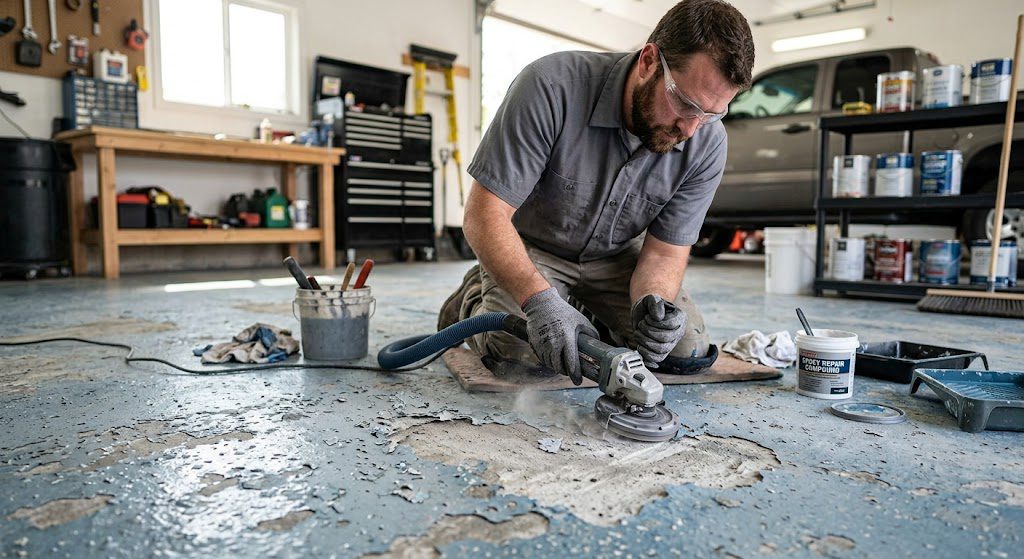
Proper equipment: Professional contractors use tools such as diamond grinders and industrial vacuums to prepare the concrete before applying the coating.
Clear communication: A good contractor should explain the process, answer questions, and provide a clear written estimate without rushing the decision.
Written warranty: A written warranty should clearly explain what is covered and for how long.
Past projects and reviews: Photos of completed work and honest customer reviews can help show the contractor’s experience and quality.
15 Questions to Ask Before Hiring an Epoxy Floor Contractor
Question 1: How Many Years Have You Installed Epoxy Flooring?
Start with experience. Epoxy flooring may look simple, but the work involves much more than just applying a coating to concrete. Experience with different floors can help a contractor handle cracks, old coatings, moisture, and heavy use.
Good answer: The contractor can explain how long they have been doing this work and share examples of past jobs.
Red flag: They give unclear answers or have little experience to show.
Question 2: Can You Show Examples of Similar Projects?
A garage does not have the same flooring needs as a warehouse or commercial space. Ask to see projects similar to the property type under construction. Photos of real jobs can also give a better idea of the contractor’s work and the finishes they offer.
Good answer: The contractor can show real residential, commercial, or industrial projects.
Red flag: They only have stock photos or cannot show similar work.
Question 3: Are You Licensed and Insured?
It is worth checking whether the contractor has the licenses required for the work and carries proper insurance. Requirements can vary depending on the location and type of project.
Good answer: The contractor answers clearly and can provide proof when requested.
Red flag: They avoid the question or will not provide any documentation.
Question 4: What Type of Epoxy Flooring System Do You Recommend?
There are several types of epoxy flooring. Some projects may need a solid epoxy system, while others may be better suited to decorative flakes, quartz, metallic finishes, or a heavier industrial system. The choice should be based on how the floor will be used, the amount of traffic, moisture, chemicals, and the condition of the concrete.
Good answer: The contractor explains why a particular system is being recommended.
Red flag: They use the same flooring system for every job.
Question 5: How Do You Prepare the Concrete Before Installation?
This is one of the most important questions to ask. The coating needs a properly prepared surface. Depending on the floor, preparation may include diamond grinding, removing an old coating, fixing cracks, cleaning stains, and removing dust. Skipping these steps can lead to adhesion problems later.
Good answer: The contractor walks through the preparation work before talking about the coating.
Red flag: The plan is simply to sweep the floor and put epoxy over it.
Question 6: Do You Test for Moisture Before Installation?
Moisture inside concrete can create problems for some flooring systems. It may lead to bubbling, blistering, or peeling if the conditions are not right for the coating. Ask how the contractor checks for moisture and what happens if the readings are too high.
Good answer: The contractor has a clear moisture testing process and can explain what the results mean.
Red flag: They say moisture is not something they need to check.
Question 7: How Many Coats Will Be Applied?
An epoxy floor can have more than one layer. Depending on the system, there may be a primer, a base coat, a decorative layer, and a top coat. The number of coats is not the only thing that matters. Each layer should have a reason for being there.
Good answer: The contractor explains the layers and what each one is for.
Red flag: They cannot tell what products or layers will be used.
Question 8: What Products and Brands Do You Use?
Ask what products will be used on the floor. Different products are made for different conditions. For example, a floor exposed to chemicals or heavy equipment may need a different system than a lightly used residential epoxy flooring contractor garage.
Good answer: The contractor names the products and explains why they fit the project.
Red flag: They will not provide basic information about the materials.
Question 9: What Warranty Do You Provide?
Before signing anything, ask about the warranty. Find out whether it covers the materials, the installation, or both. Also ask what the warranty does not cover. Things such as moisture, concrete movement, or damage from misuse may have separate terms.
Good answer: The warranty is written down and easy to understand.
Red flag: The contractor promises a warranty but will not provide the details in writing.
Question 10: How Long Will Installation Take?
Ask about the full schedule, not just how long it takes to apply the coating. The job may include concrete crack repairs, coating, curing, and cleanup. The floor may also need to stay closed to foot or vehicle traffic for a certain amount of time.
Good answer: The contractor gives a realistic timeline and explains when the floor can be used.
Red flag: They promise to finish very quickly without explaining the preparation or curing process.
Question 11: How Should the Floor Be Maintained?
Epoxy floors are fairly easy to clean, but they still need regular care. Dirt, grit, spills, and chemicals should not be left on the surface for long periods. Maintenance can also be different for a garage, warehouse, kitchen, or facility with heavy equipment.
Good answer: The contractor explains how to clean and care for the floor.
Red flag: They say the floor will never need cleaning or maintenance.
Question 12: What Is Included in the Written Estimate?
A written estimate should show exactly what is included in the job. This makes it easier to compare quotes and avoid unexpected costs later. Check that the estimate covers labor, materials, concrete preparation, crack repairs, moisture testing, coating layers, warranty, cleanup, and the expected timeline.
Good answer: The contractor provides a detailed estimate that lists each part of the work, the materials used, the required preparation, and any potential extra costs.
Red flag: The estimate shows only a single total price without explaining what it includes or what might cost extra later.
Question 13: Who Will Actually Perform the Installation?
Some companies use their own crews. Others hire subcontractors for certain parts of the job. Ask who will prepare the concrete and who will install the flooring. It is also useful to know who will be in charge of the project.
Good answer: The contractor clearly states who will do the work.
Red flag: They cannot tell who will be working on the property.
Question 14: Can the Flooring System Be Customized?
Epoxy floors can come in different colors and finishes. Depending on the system, options may include decorative flakes, quartz, metallic finishes, different gloss levels, and slip-resistant surfaces.
If the floor is often wet or comes into contact with oil, ask about slip resistance before choosing the finish.
Good answer: The contractor explains which finishes make sense for the space.
Red flag: They push one finish without asking how the floor will be used.
Question 15: What Happens If Repairs Are Needed Later?
No floor stays perfect forever. Heavy traffic, impacts, chemicals, concrete movement, or other problems can lead to repairs over time. Ask whether the contractor handles repairs and what happens if part of the floor becomes damaged.
Good answer: The contractor explains how repairs are handled and whether they offer follow-up service.
Red flag: There is no clear answer about future concrete repairs or maintenance.
Bonus Questions for Commercial Property Owners
Commercial property owners may need to ask additional questions before hiring an epoxy floor contractor.
Will the floor handle forklift traffic?
Can the system handle heavy machinery?
Will it resist the chemicals used at the facility?
Is a slip-resistant finish needed?
Can the flooring handle hot water or sudden temperature changes?
Food processing and commercial kitchen environments may also require flooring systems designed around sanitation, cleaning chemicals, moisture, and slip resistance.
OSHA also requires walking working surfaces in general industry to be kept clean, orderly, and as dry as possible, with hazardous conditions corrected or guarded against.
Common Red Flags When Hiring an Epoxy Floor Contractor
Some warning signs are easy to spot:
The price is far lower than every other estimate.
No written quote.
The contractor will not explain surface preparation.
Moisture testing is dismissed without explanation.
No clear warranty is provided.
No references or project examples.
Insurance information is unavailable.
Promises an unrealistic installation time.
These signs do not automatically prove poor workmanship, but they are reasons to ask more epoxy floor installation questions before signing an agreement.
Professional Contractor vs Inexperienced Contractor
Factor
Professional Contractor
experienced Contractor
Experience
Explains past projects clearly
Limited project history
Preparation
Uses suitable mechanical preparation
May rely on basic cleaning
Moisture testing
Evaluates slab moisture
May skip testing
Warranty
Provides written terms
Vague or verbal promises
Equipment
Uses equipment suited to the floor
Limited
Materials
Matches products to the environment
May use one system everywhere
Performance
Focuses on preparation and system selection
Often focuses mainly on appearance
Costs
May reduce repair needs
Lower upfront cost may lead to added repairs
Looking for a professional epoxy flooring service near me? Choose an experienced contractor who understands proper floor preparation and can recommend the right system for the space.
Choosing the Right Flooring System for Different Properties
The right flooring system depends on how the space is used.
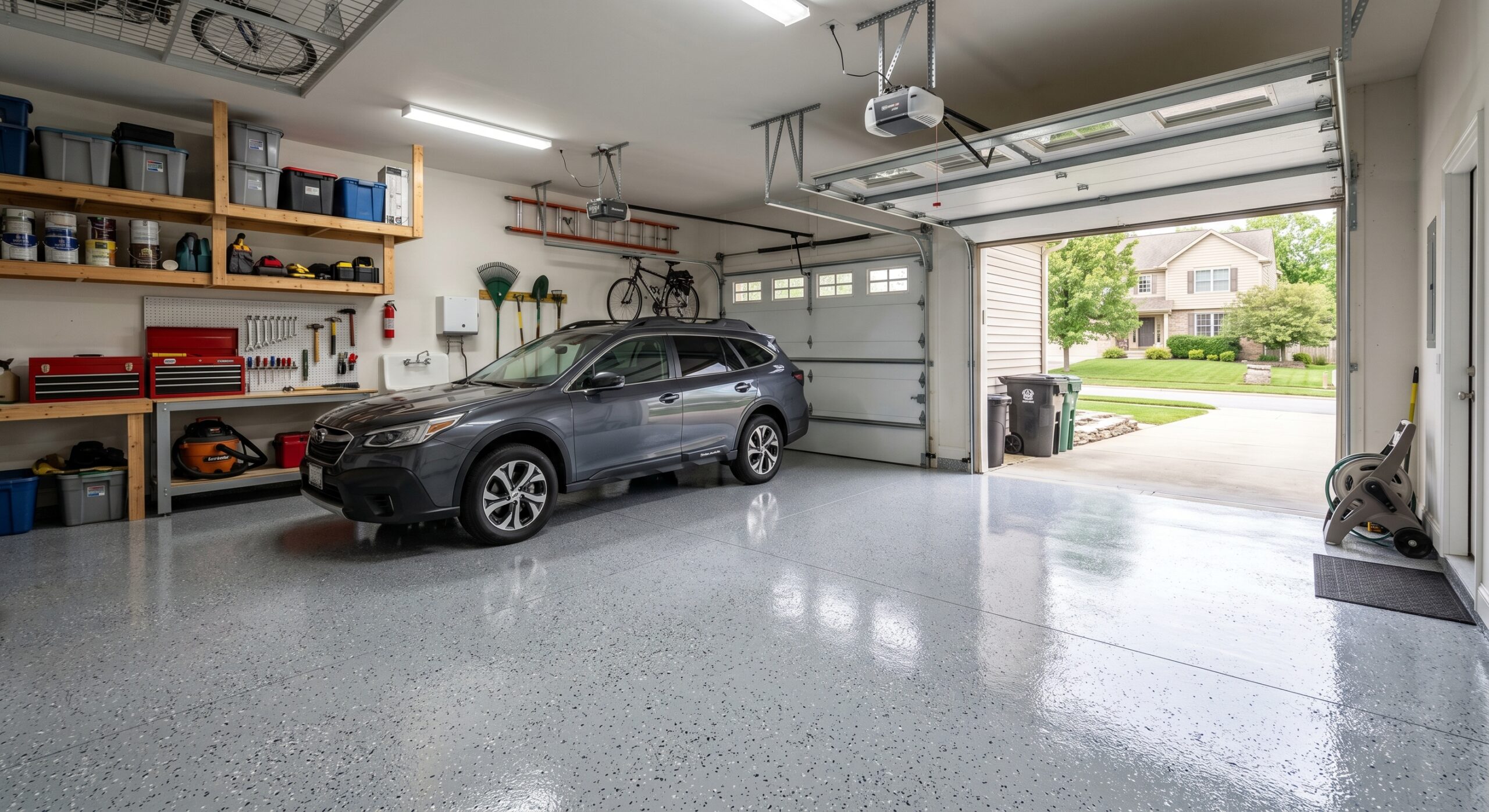
Residential garages need durable surfaces that resist tire marks, oil stains, and road salt.
Basements require moisture-tolerant systems.
Showrooms prioritize appearance while maintaining durability.
Warehouses demand impact resistance and tolerance for heavy equipment.
Commercial kitchens need chemical- and slip-resistant surfaces that withstand frequent washing.
Manufacturing facilities may require anti-static properties or resistance to specific chemicals.
Some projects require more than standard epoxy coatings. High-impact commercial environments may benefit from epoxy urethane mortar flooring systems, which provide excellent resistance to heavy traffic, chemicals, moisture, and thermal shock. Selecting the right flooring system depends on how the space will be used rather than choosing a single coating for every application.
Why Experience Makes a Difference
Experience matters because no two concrete floors are exactly alike. The age and condition of the concrete, previous coatings, cracks, moisture, and daily use can all affect the work.
An experienced contractor knows what to check before installation and can adjust the preparation and epoxy flooring system to suit the project.
Old Stone Restoration and Installation Corp has over 35 years of experience working on residential, commercial, and industrial flooring projects. That experience includes working with different concrete conditions and flooring needs.
Making the Right Decision
Hiring an epoxy floor contractor should involve more than comparing prices. Ask about surface preparation, materials, moisture testing, warranties, installation time, and previous work. A good contractor should be willing to explain the work and provide a clear estimate. Taking the time to compare these details can help avoid unexpected costs and problems later.
For professional concrete repair evaluation and service across Long Island, contact Old Stone Restoration and Installation Corp. at (631) 821 5619.
FAQs
How long does epoxy flooring typically last?
Properly installed epoxy flooring may last 10 to 20 years or longer depending on traffic levels, maintenance practices, and environmental conditions. Industrial environments with heavy equipment often see shorter lifespans than residential garages with light use.
How much does epoxy flooring cost?
Costs vary significantly based on surface condition, preparation requirements, coating system, and project size. Professional installations for residential garages typically range from $3 to $12 per square foot. Commercial epoxy flooring contractors and industrial projects may cost more due to enhanced system requirements.
Can epoxy be installed over damaged concrete?
Minor cracks and surface damage can often be repaired before coating application. Severely damaged concrete may require more extensive repair or replacement before epoxy systems will perform properly. Contractors should assess the condition of the concrete and recommend appropriate repairs.
Does every floor need moisture testing?
Professional contractors typically test moisture as standard practice regardless of apparent conditions. Concrete that appears dry may contain moisture levels high enough to cause coating failure. Testing provides documentation and helps prevent problems.
Can epoxy floors become slippery?
Smooth epoxy surfaces can become slippery when wet. Slip-resistant additives, textured aggregates, or textured topcoats improve traction. Contractors should recommend an appropriate level of slip resistance for the intended environment.
How long before driving on the floor is safe?
Most epoxy systems allow light foot traffic within 24 to 48 hours. Vehicle traffic typically requires five to seven days of curing time. Specific timelines depend on the coating system, temperature, and humidity conditions.
What is the difference between epoxy and urethane mortar
Epoxy coatings create thin protective surfaces suitable for many applications. Urethane mortar systems are thicker, troweled toppings designed for severe environments with heavy impact, chemical exposure, or thermal shock.
How can property owners verify contractor qualifications?
Request documentation of licensing, insurance, and project references. Review portfolios showing similar completed projects. Check online reviews across multiple platforms. Ask detailed questions about preparation methods and coating systems.
Is DIY epoxy worth considering?
DIY kits work for some applications but typically lack the durability and performance of professional installations. Improper preparation causes most DIY failures. Professional installations generally provide better long-term value despite higher initial costs.
How often does epoxy flooring require maintenance?
Regular sweeping and mopping keep epoxy floors clean. Most systems benefit from periodic deep cleaning. High-traffic areas may require spot repairs or recoating every few years to maintain appearance and protection.
How to choose an epoxy flooring contractor?
Start by checking the contractor’s experience and past projects. Ask how the concrete will be prepared, whether moisture testing is included, what type of epoxy system is recommended, and who will do the installation. A reliable contractor should also provide a clear written estimate and explain the warranty before the work begins.
Epoxy flooring can usually be installed over existing concrete. In fact, existing concrete is one of the most common surfaces used for epoxy flooring. However, simply pouring epoxy over an old floor is not enough. The concrete needs to be checked, cleaned, repaired, and prepared so the epoxy can bond properly.
The condition of the concrete matters more than its age. An older concrete floor can be a good base if it is strong and free from major problems. A newer floor can still cause trouble if it has too much moisture, oil, dirt, weak areas, or an old coating that prevents the epoxy from sticking.
Sherwin-Williams states that concrete receiving a bonded floor system should be structurally sound, clean, and properly prepared. Its guidance also calls for checking the concrete, removing weak areas, dealing with contaminants, creating the right surface texture, and repairing surface problems before the flooring system is installed.
So, the short answer is yes—but the existing concrete must be ready for epoxy first.
When Can Epoxy Flooring Be Installed Over Existing Concrete?
Epoxy can often be installed over existing concrete when the slab is strong enough to support the new flooring system and does not have serious moisture or structural problems. Small surface defects may be repaired before the epoxy is applied, while larger problems may require more extensive concrete repair.
The floor should also be free from materials that can stop the epoxy from bonding. Oil, grease, dirt, dust, old coatings, and other contaminants may need to be removed. The surface also needs the right texture so the epoxy can grip the concrete instead of simply sitting on top of it.
The age of the concrete is not the only thing to consider. An old but solid floor may be a better base than a newer floor that is weak or has moisture problems. A professional inspection can help determine whether the concrete is suitable and what preparation is needed.
Sherwin-Williams recommends inspecting the substrate, removing nondurable concrete, removing contaminants, creating a suitable surface profile, and repairing surface irregularities before applying a bonded polymer floor system.
Can You Put Epoxy Over Old Concrete?
Yes, but the old concrete cannot simply be covered without preparation. The existing floor needs to be evaluated first. If the surface is dirty, oily, weak, smooth, or damaged, those problems need to be handled before the epoxy goes down.
This is important because epoxy bonds to the prepared surface underneath it. If dirt or oil sits between the concrete and epoxy, the coating may not bond properly. A very smooth surface can also make it difficult for the flooring system to get the grip it needs.
Mechanical preparation is commonly used for concrete flooring projects. Diamond grinding and shot blasting can remove surface contaminants and create the surface texture needed for a strong bond. Sherwin-Williams notes that diamond grinding can also be used to remove existing coatings and adhesives, while shot blasting can prepare the concrete and remove dust through vacuuming.
This means the preparation stage is not just about making the floor look clean. It helps create the right surface for the epoxy system.
What Does Existing Concrete Need Before Epoxy Flooring?
Existing concrete needs more than a quick sweep before epoxy installation. The surface should be inspected for cracks, weak spots, holes, stains, old coatings, moisture, and other conditions that could affect the new floor.
First, loose or weak concrete may need to be removed. Next, dirt, oil, grease, and other contaminants should be cleaned away. Cracks, holes, and damaged areas may need repair. The surface may then need mechanical preparation to create the right texture.
Moisture is another important concern. Concrete can look dry on top while still holding moisture below the surface. If moisture moves through the slab and becomes trapped beneath a non-permeable flooring system, it can contribute to bubbling, peeling, or other flooring problems.
Sherwin-Williams explains that checking moisture vapor emissions and the condition of the slab is an important part of deciding how the surface should be prepared.
Do You Need to Repair Concrete Before Applying Epoxy?
In many cases, yes. The amount of repair depends on the condition of the existing floor. Small holes, surface damage, and minor imperfections may be repaired as part of the preparation process. Larger or deeper damage may need more extensive repair before the epoxy system is installed.
Epoxy can improve the appearance and performance of a concrete floor, but it should not be treated as a way to hide serious problems underneath. If the concrete is weak or badly damaged, applying a coating over it does not automatically make the base stronger.
Cracks also need attention. Some cracks may be simple surface cracks, while others may point to movement or a larger problem with the slab. The correct repair method depends on the cause and size of the damage.
Sherwin-Williams recommends removing nondurable concrete and repairing surface irregularities before applying polymer flooring. Its guidance also notes that significant cracks, pitting, and mechanical damage may need to be repaired before the primer is applied.
Can Epoxy Flooring Be Applied Over Cracked Concrete?
Epoxy flooring can sometimes be installed over concrete that has cracks, but the cracks should not simply be ignored. The type, size, location, and cause of the crack all matter.
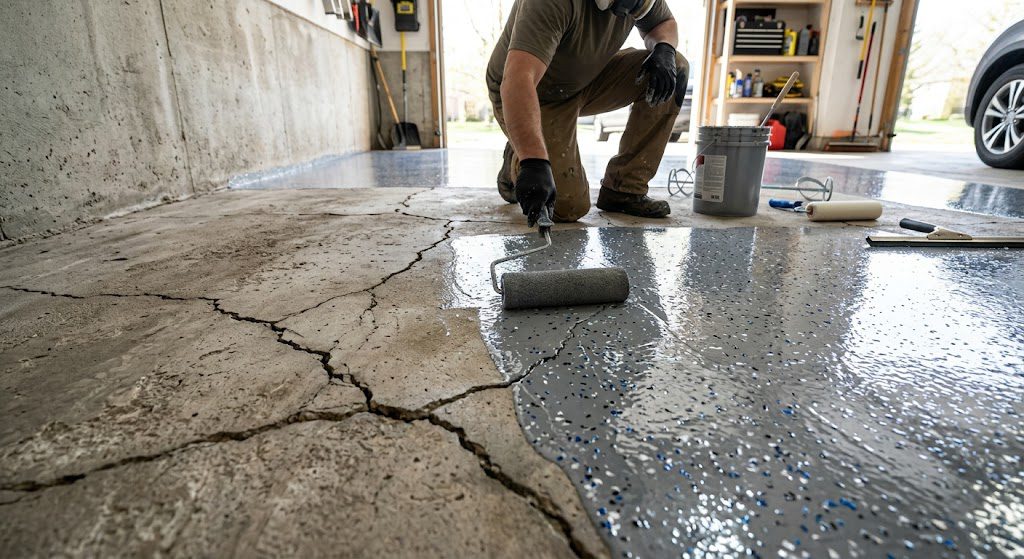
A small surface crack may require a different repair than a large crack caused by movement in the concrete. If the slab continues to move, the crack may come back and affect the new flooring system.
Before installation, the concrete should be inspected so the cause and condition of the crack can be understood. The damaged area can then be repaired using a method and material that are suitable for the selected flooring system.
This is one reason professional preparation matters. A finished epoxy floor can look smooth and clean, but the performance of the floor still depends heavily on the concrete underneath it. Proper preparation helps reduce the chance that existing surface problems will cause trouble after installation.
How Is Existing Concrete Prepared for Epoxy Flooring?
Preparing existing concrete for epoxy usually involves several steps. The exact process depends on the condition of the floor and the type of epoxy system being installed.
The first step is inspection. The installer needs to look for damage, contamination, moisture, old coatings, and other problems. Next, the surface is cleaned and contaminants are removed. Damaged areas are repaired as needed.
After that, the concrete may be mechanically prepared using equipment such as diamond grinders or shot blasters. These methods can remove unwanted surface material and create a texture that helps the epoxy bond to the concrete.
Dust must also be removed after mechanical preparation. A clean surface is important because loose dust can interfere with adhesion.
Sherwin-Williams describes inspection, decontamination, surface profiling, and repair as important parts of concrete preparation. Its current guide also identifies diamond grinding and shot blasting as common methods for preparing concrete for resin flooring.
Why Is Surface Preparation So Important for Epoxy Flooring?
Surface preparation is one of the most important parts of an epoxy flooring project because the new floor needs a clean and suitable base. Even a high-quality epoxy product can have problems if it is applied over a poor surface.
Think of it like putting tape on a dusty wall. The tape may look fine at first, but it will not hold as well as it would on a clean surface. Epoxy works in a similar way. It needs the right surface conditions to form a strong bond.
Oil, grease, dust, old coatings, weak concrete, and moisture can all create problems. Mechanical preparation can also give the concrete the texture needed for the flooring system to bond.
Sherwin-Williams specifically describes proper surface preparation as a major factor in the short- and long-term performance of polymer floor systems.
Can You Apply Epoxy Over an Old Epoxy Floor?
Sometimes, yes. An existing epoxy floor may be recoated if it is well bonded and suitable for the new system. However, the old coating still needs to be cleaned and properly prepared.
Sherwin-Williams explains that an existing seamless resin floor can sometimes be resurfaced. The existing surface should be cleaned, degreased, mechanically abraded to remove its gloss, and vacuumed thoroughly before another coating is applied.
It is also important to know what type of coating is already on the floor. Different resin systems may not always be compatible. If the existing coating is unknown, testing and professional evaluation can help avoid a poor bond or other problems.
So, applying new epoxy over old epoxy may be possible, but it should be treated as a preparation and compatibility question rather than a simple cover-up job.
Can Epoxy Go Over Concrete With Oil or Grease Stains?
Epoxy should not simply be applied over a concrete surface covered with oil or grease. These substances can interfere with the bond between the concrete and the new flooring.
This can be especially important in garages, workshops, factories, warehouses, and other areas where oil or chemicals may have been spilled over time. Cleaning the surface is therefore an important part of preparing old concrete.
The type of contamination and how deeply it has entered the concrete can affect the preparation method. A professional installer may need to use cleaning and mechanical preparation methods to remove or reduce the contamination before applying the flooring system.
The goal is to create a clean, sound surface that is suitable for the selected epoxy system. Sherwin-Williams includes decontamination as one of the main stages of concrete surface preparation before bonded polymer flooring is installed.
Does Moisture in Concrete Affect Epoxy Flooring?
Yes. Moisture is one of the conditions that should be checked before installing epoxy flooring over existing concrete.
Concrete can contain moisture even when the surface looks dry. If moisture moves through the slab and becomes trapped beneath a flooring system that does not allow it to pass through easily, it can contribute to problems such as blistering or loss of adhesion.
This does not mean every concrete floor with some moisture is automatically unsuitable for epoxy. Some flooring systems and primers are designed to handle certain moisture conditions. The correct choice depends on the actual moisture level, the slab, and the product system being used.
Sherwin-Williams notes that moisture vapor emissions should be assessed before installation, and it also provides moisture-tolerant epoxy primer systems for certain conditions.
Because moisture conditions can be difficult to judge just by looking at the floor, testing is an important part of professional preparation.
How Long Should New Concrete Dry Before Epoxy?
New concrete needs enough time to cure and dry before many epoxy or resin flooring systems are installed. The exact waiting time depends on the flooring system, concrete conditions, moisture level, and manufacturer’s requirements.
Sherwin-Williams notes that a commonly used minimum curing period is 28 days, while also explaining that actual conditions can require a longer period. Moisture testing can help determine whether the slab is ready for a particular coating system.
This is important because a concrete floor can look dry before it is ready for an epoxy coating. Putting epoxy down too early can trap moisture and increase the risk of blistering, peeling, or other problems.
For an existing concrete floor, the issue is usually less about how old the floor is and more about its current condition and moisture behavior. A professional installer should check the floor and follow the requirements of the selected epoxy system.
Can Epoxy Flooring Cover Small Imperfections in Concrete?
Yes, some epoxy flooring systems can cover or smooth certain small surface imperfections. However, this does not mean every hole, crack, or damaged area can be hidden under epoxy.
Some poured or self-leveling epoxy systems have enough thickness to smooth minor scratches, small divots, and other surface imperfections. Sherwin-Williams explains that certain poured epoxy systems can help smooth small surface defects, but it also notes that other deficiencies require patching, filling, or repair before coating.
The difference matters because putting a thick coating over a serious problem does not fix the problem underneath. The installer needs to decide which imperfections can be handled by the flooring system and which ones need separate repair.
This approach can help the finished floor last longer and perform as expected.
What Happens If Epoxy Is Installed Over Poor Concrete?
If epoxy is installed over weak, dirty, wet, or poorly prepared concrete, the flooring may not perform as expected. Problems can include poor adhesion, peeling, bubbling, cracks showing through, or early wear.
The epoxy itself may not be the problem. The issue can start with the surface underneath it.
For example, if oil remains on the concrete, the epoxy may have difficulty bonding. If loose concrete remains under the coating, that weak material can affect the new floor. If moisture is moving through the slab, it may create pressure beneath the coating.
This is why experienced installers spend time preparing the existing concrete before applying the flooring. Sherwin-Williams states that the condition of the concrete substrate is a key factor in determining how a resin floor system should be installed.
Is Epoxy Flooring a Good Choice for Old Concrete Floors?
Epoxy can be a good option for many old concrete floors when the existing slab is suitable and properly prepared. It can create a smooth, sealed surface that is easier to clean and can handle regular traffic when the right system is selected.
However, the best flooring system depends on how the floor will be used. A quiet office floor may have different needs from a warehouse, factory, automotive shop, commercial kitchen, or industrial facility.
Heavy traffic, forklifts, impacts, chemicals, heat, moisture, and cleaning methods can all affect the type of flooring system that should be used. Some demanding environments may require a thicker or more specialized resin flooring system rather than a basic epoxy coating.
The condition of the existing concrete should therefore be considered along with the needs of the building. A proper evaluation can help determine whether epoxy is appropriate and which system will provide the needed performance.
When Should You Not Put Epoxy Over Existing Concrete?
Epoxy should not be applied over existing concrete without first addressing serious problems with the slab or surface. Examples include badly deteriorated concrete, significant moisture problems, heavy contamination that has not been properly treated, or surfaces that are otherwise unsuitable for the selected flooring system.
Old coatings can also require special attention. Some existing coatings may need to be removed, while others may be suitable for recoating after proper preparation. The compatibility of the old and new materials should be considered.
The same rule applies to concrete that has serious structural problems. Epoxy is a floor finish; it should not be viewed as a replacement for repairing a severely damaged concrete slab.
Sherwin-Williams advises against coating structurally unsound concrete and explains that different existing substrates and coatings may require specific preparation methods.
Should You Hire an Epoxy Floor Contractor for Existing Concrete?
For a small residential project, some people may consider installing epoxy themselves. Larger commercial and industrial floors are different. Existing concrete may have hidden problems that are difficult to identify without the right experience and equipment.
A professional installer can inspect the concrete, identify areas that need repair, check moisture conditions, remove contamination, prepare the surface, and select a flooring system that matches how the space will be used.
Professional installation is also about more than spreading epoxy. Sherwin-Williams explains that successful poured epoxy flooring requires evaluation of the slab, moisture assessment, surface cleaning, and suitable mechanical preparation before the coating is applied.
For businesses, getting the preparation right can be especially important because a flooring failure can interrupt daily work and lead to another repair project.
How to Prepare Existing Concrete for Epoxy Flooring
The exact preparation process depends on the condition of the floor, but the general process starts with an inspection. The installer checks the concrete for damage, cracks, weak areas, contamination, moisture, and existing coatings.
Next, dirt, oil, grease, dust, and other unwanted materials are removed. Damaged areas may be repaired, and the surface is mechanically prepared when needed. Diamond grinding or shot blasting can be used to create a suitable surface profile and remove unwanted material.
The prepared floor is then cleaned again so loose dust and debris do not remain before the coating is installed. The selected epoxy system is applied according to its product requirements, including the correct conditions for temperature, moisture, application, and curing.
The important point is that there is no single preparation method that works for every old concrete floor. The condition of the existing surface determines what needs to be done.
How Much Does It Cost to Epoxy an Existing Concrete Floor?
The cost of epoxy flooring over existing concrete depends on several factors, so there is no single price that applies to every project. The size of the floor is one factor, but it is not the only one.
The condition of the concrete can make a major difference. A clean, sound floor that needs limited preparation may require less work than an old floor with cracks, oil contamination, damaged concrete, or an existing coating that needs to be removed.
The type and thickness of the flooring system also affect the cost. A simple coating may have different material and labor needs than a heavy-duty system designed for forklifts, industrial traffic, chemical exposure, or other demanding conditions.
For this reason, a proper site evaluation is more useful than choosing a contractor based only on a price per square foot. The goal should be to select a flooring system that fits the floor’s condition and the way the space will be used.
What Are the Benefits of Epoxy Flooring Over Existing Concrete?
Installing epoxy over suitable existing concrete can provide several benefits. It can give an old floor a cleaner and more uniform appearance while creating a sealed surface that is easier to maintain.
The right epoxy system can also provide resistance to everyday wear, chemicals, and heavy traffic. In commercial and industrial spaces, the flooring can be designed around the needs of the building, including areas where forklifts, equipment, spills, or frequent cleaning are common.
Another benefit is that an existing concrete slab does not always need to be completely removed before a resin flooring system is installed. This can make the project more practical when the concrete is structurally suitable.
However, these benefits depend on correct product selection and preparation. Epoxy flooring is not a magic layer that fixes every concrete problem. The better the base and preparation, the better the chance of getting the expected result.
Epoxy Flooring Over Existing Concrete: Final Answer
Yes, epoxy flooring can be installed over existing concrete in many situations. The concrete does not have to be new for epoxy to work. What matters is whether the existing floor is sound, clean, properly prepared, and suitable for the flooring system.
Before installation, the floor should be checked for cracks, weak concrete, oil, grease, old coatings, moisture, and other problems. Repairs and surface preparation should be completed before the epoxy is applied.
If you are unsure about the condition of an existing concrete floor, getting it inspected before choosing a flooring system can help prevent costly mistakes. The right preparation can make a major difference in how well the finished floor performs.
Choosing the Right Epoxy Flooring Service
If your existing concrete floor is worn, difficult to maintain, or no longer suitable for your workplace, Epoxy Flooring Service from Old Stone Restoration and Installation Corp. can be considered as part of a flooring upgrade. The company has more than 35 years of experience working with restoration and flooring projects. For an existing concrete floor, the important first step is understanding its condition rather than simply covering it. A proper evaluation can help determine whether the concrete needs cleaning, grinding, repairs, or a more suitable flooring system before installation. This approach helps businesses choose a floor based on how the space is actually used, whether it needs to handle regular foot traffic, equipment, chemicals, or other demanding conditions.
FAQs
Can epoxy flooring be installed directly over concrete?
Yes, epoxy flooring can be installed over concrete when the concrete is suitable and properly prepared. The surface should be clean, sound, and free from problems that could prevent bonding. Cracks, damaged areas, oil, grease, old coatings, and moisture may need to be addressed first. Epoxy should not simply be poured over a dirty or weak floor. Proper surface preparation helps the new flooring bond to the concrete and perform as expected.
Do you have to grind concrete before epoxy?
Not every floor requires exactly the same preparation method, but concrete often needs mechanical preparation before epoxy is installed. Diamond grinding and shot blasting are commonly used to remove surface contaminants and create a suitable surface texture. The correct method depends on the existing concrete and the flooring system. The goal is to create a clean and properly prepared surface that allows the epoxy to bond well.
Can epoxy cover old cracks in concrete?
Epoxy may cover some small surface imperfections, but cracks should be inspected and repaired when needed before the coating is applied. A crack caused by movement may return even after the surface is coated. Larger cracks or damaged areas may require specific repair work. The right approach depends on the size, location, and cause of the crack rather than simply putting more epoxy over it.
Can you epoxy a concrete floor that has oil stains?
Oil and grease should be properly removed before epoxy installation. These contaminants can interfere with adhesion and make it harder for the new floor to bond properly. The required cleaning and preparation depend on how much contamination is present and how deeply it has affected the concrete. Decontamination is an important part of preparing an existing concrete surface for a bonded floor system.
Can epoxy flooring be installed over old epoxy?
Yes, an existing epoxy floor can sometimes be recoated. The old floor must be well bonded, cleaned, degreased, and mechanically prepared so the new coating can bond. The compatibility of the existing coating with the new system should also be considered. If the type of old coating is unknown, professional advice is helpful before applying a new system.
How long does concrete need to cure before epoxy?
Many epoxy and resin flooring systems require new concrete to cure for about 28 days, but the actual requirement depends on the product and site conditions. Moisture testing may also be needed because concrete can still contain moisture even when its surface looks dry. Always follow the requirements of the selected flooring system rather than relying only on a fixed number of days.
What happens if epoxy is applied to wet concrete?
Excess moisture can cause problems beneath an epoxy floor because the moisture may become trapped under the coating. This can contribute to blistering, peeling, or loss of adhesion. Some specially designed primers can tolerate certain moisture conditions, but they do not mean every wet floor is ready for epoxy. The moisture condition should be tested and matched with a suitable flooring system.
Can epoxy flooring fix uneven concrete?
Some thicker or self-leveling epoxy systems can smooth certain small surface imperfections, but they should not be expected to fix every uneven or badly damaged concrete floor. Large holes, deep damage, major cracks, and weak concrete may need repair or leveling before the epoxy system is installed. The condition of the existing slab should be checked before choosing the flooring system.
Is epoxy flooring good for old concrete?
Epoxy can be a good choice for an old concrete floor if the slab is sound and can be properly prepared. The age of the concrete alone does not decide whether epoxy will work. Its strength, moisture condition, contamination, damage, and existing coatings are more important. A professional evaluation can help determine whether epoxy or another flooring system is the better option.
Should I hire a professional epoxy floor contractor?
For commercial and industrial floors, professional installation can be helpful because preparation involves more than cleaning the surface. The concrete may need inspection, moisture assessment, repairs, mechanical preparation, and careful product selection. Proper installation also helps ensure that the flooring system is suited to the traffic and conditions inside the building.
Every year, thousands of workers across the United States suffer injuries from slips, trips, and falls. According to the Bureau of Labor Statistics, these incidents remain among the leading causes of workplace injuries, accounting for a significant portion of workers’ compensation claims. What many business owners fail to recognize is that the floor beneath their feet plays a critical role in preventing these accidents.
Commercial and industrial floors endure constant stress from heavy equipment, chemical spills, and daily foot traffic. Over time, concrete can crack, wear down, and create safety risks. Epoxy flooring provides a durable solution by creating a seamless, high-performance surface designed to withstand demanding environments.
However, choosing the right coating is only part of the process. Professional installation plays a key role in ensuring proper adhesion, durability, and long-term performance. A professional epoxy flooring service provider can help businesses achieve safer, more reliable flooring built for daily use.
Quick Answer: Does Epoxy Flooring Improve Workplace Safety?
Yes. Epoxy flooring helps create safer work environments by providing a seamless, durable surface that reduces trip hazards, improves traction with anti-slip options, resists chemical damage, and supports better visibility in busy facilities.
Why Workplace Flooring Plays a Bigger Role Than Most Businesses Realize
Walk into any warehouse, manufacturing plant, or commercial kitchen. Most people notice the equipment, the products, and the workers. Almost nobody thinks about the floor. This oversight can prove costly.
Damaged concrete creates uneven surfaces where employees can stumble. Oil, water, and chemical spills turn smooth floors into skating rinks. Poor lighting makes it difficult for forklift operators to see pedestrians or obstacles.
Beyond immediate injury risks, flooring conditions affect employee fatigue. Workers who stand on hard, uneven surfaces all day experience more foot and back pain. This discomfort leads to reduced productivity and increased absenteeism.
OSHA compliance also comes into play. Businesses have a responsibility to maintain walking surfaces in safe condition. Cracked, deteriorating, or slippery floors can result in citations, fines, and increased liability exposure.
Industries where flooring matters most include warehouses, manufacturing facilities, food processing plants, automotive shops, healthcare settings, and commercial kitchens. Each environment presents unique challenges that standard concrete struggles to address.
What is Epoxy Flooring?
At its core, epoxy flooring consists of a resin and hardener mixture applied over concrete. When these two components combine, a chemical reaction creates a rigid plastic coating that bonds directly to the substrate. The result is a seamless, durable surface that can withstand heavy use.
This coating system differs from paint. While paint sits on top of concrete, epoxy penetrates the surface and forms a chemical bond. This creates superior adhesion and longevity.
Epoxy flooring systems come in various formulations depending on the application. Decorative systems add color, patterns, and visual appeal for showrooms and retail spaces. Industrial systems prioritize chemical resistance, impact strength, and durability for demanding environments.
Thin mil coatings work for light-duty applications, while heavy-duty mortar systems can reach a quarter inch or more in thickness. An experienced epoxy floor contractor can recommend the appropriate system based on the specific demands of each facility.
How Epoxy Flooring Improves Workplace Safety
Understanding how epoxy flooring enhances safety helps business owners make informed decisions about their facilities.
Reduces Slips, Trips, and Falls
Slip resistance remains one of the most important safety features of epoxy flooring. Installers can incorporate anti-slip additives into the topcoat, creating a textured surface that provides traction even when wet. This proves especially valuable in environments where spills occur frequently.
Commercial kitchens deal with water, grease, and food debris constantly. Manufacturing plants contend with oil and chemical spills. Warehouses see condensation and moisture from loading dock operations. Standard concrete becomes dangerously slippery under these conditions.
The textured finishes available with epoxy systems address this problem directly. From fine grit for light-duty areas to aggressive textures for heavy industrial use, slip resistance can be customized to match the environment.
Creates a Seamless Surface
Traditional flooring materials create hazards at every joint, crack, and transition point. Tile grout deteriorates and creates uneven spots. Concrete joints separate and create trip hazards. Sheet flooring lifts at the edges and catches feet.
Epoxy flooring eliminates these problems by creating a continuous, seamless surface. No grout lines to crumble. No joints to separate. No edges to catch carts, pallet jacks, or feet. This seamless characteristic reduces trip hazards significantly throughout the facility.
Improves Chemical Resistance
Chemicals create flooring hazards in two ways. First, spilled chemicals can make surfaces slippery. Second, chemical exposure degrades concrete over time, creating pitting, erosion, and uneven surfaces.
Epoxy flooring resists a wide range of chemicals including oils, greases, acids, solvents, and industrial cleaners. This resistance prevents the surface degradation that leads to safety hazards. It also makes cleanup easier, reducing the time that potentially hazardous spills remain on the floor.
For facilities with extreme chemical exposure, specialized formulations offer even greater protection. Acid-resistant systems, novolac epoxy topcoats, and urethane mortar systems can handle environments that would quickly destroy standard coatings.
Makes Cleaning Easier
A clean floor is a safer floor. Dust, debris, and spills all create hazards. The easier a floor is to clean, the more likely it stays clean.
The nonporous, seamless nature of epoxy flooring makes cleaning simple and efficient. Dust and debris cannot hide in cracks or grout lines. Spills sit on the surface rather than absorbing into the substrate. Regular sweeping and mopping keep the surface in optimal condition.
This ease of maintenance proves especially important in healthcare settings and food processing facilities where sanitation requirements are strict. Bacteria and contaminants cannot penetrate the sealed surface, making it easier to maintain hygienic conditions.
Improves Visibility
Many facilities overlook lighting as a safety factor. Poor visibility leads to accidents, especially in areas with vehicle and pedestrian traffic.
Glossy epoxy finishes reflect light effectively, brightening the entire space. This improved light reflection helps forklift operators see pedestrians, equipment, and obstacles more clearly. It also reduces eye strain for workers performing detailed tasks.
Some facilities report reduced lighting costs after installing reflective epoxy floors. The improved light distribution allows the same fixtures to illuminate larger areas more effectively.
Handles Heavy Machinery Without Surface Damage
Forklifts, pallet jacks, and heavy equipment put tremendous stress on flooring surfaces. Standard concrete develops wear patterns, ruts, and damage over time. This damage creates uneven surfaces and trip hazards.
Industrial epoxy systems and mortar systems provide exceptional impact resistance and compressive strength. These coatings can withstand the daily abuse of heavy equipment traffic without deteriorating. This durability maintains a smooth, even surface that reduces hazards associated with damaged flooring.
Prevents Concrete Dust
Few business owners realize that bare concrete constantly generates dust. As the surface wears, it releases fine particles into the air. This concrete dust creates multiple problems.
Air quality suffers when dust circulates through the facility. Workers may experience respiratory irritation. Fine particles can damage sensitive equipment. The dust settles on products, surfaces, and equipment, requiring constant cleaning.
Epoxy flooring seals the concrete surface, eliminating this dust generation. The sealed surface cannot deteriorate in the same way, keeping the environment cleaner and healthier.
Supports Safety Line Markings
Clear visual communication enhances safety in any facility. Designated walkways, forklift lanes, emergency exits, loading zones, and hazard areas all benefit from clear floor markings.
Epoxy flooring provides an ideal canvas for safety line markings. The smooth, durable surface accepts painted lines that remain visible for years. Color zones can be incorporated directly into the flooring system, creating permanent demarcation that cannot wear away like painted lines on concrete.
Improve Fire Safety
Certain epoxy formulations offer enhanced fire performance characteristics. While standard epoxy is not fireproof, specific systems can provide improved resistance to flame spread. Facilities with particular fire safety requirements should discuss appropriate formulations with their epoxy floor contractor.
Reduces Long-Term Maintenance Hazards
Deferred maintenance creates hazards over time. Small cracks become large cracks. Potholes develop. Surfaces become increasingly uneven. Each of these conditions increases injury risk.
Epoxy flooring reduces long-term maintenance needs by protecting the underlying concrete. The durable surface coating prevents the wear, chemical damage, and impact degradation that would otherwise require constant repair. This protection maintains safe conditions year after year with minimal intervention.
Industries That Benefit Most from Epoxy Flooring
Different industries face unique flooring challenges, but epoxy systems can address most of them effectively.
Warehouse and Distribution
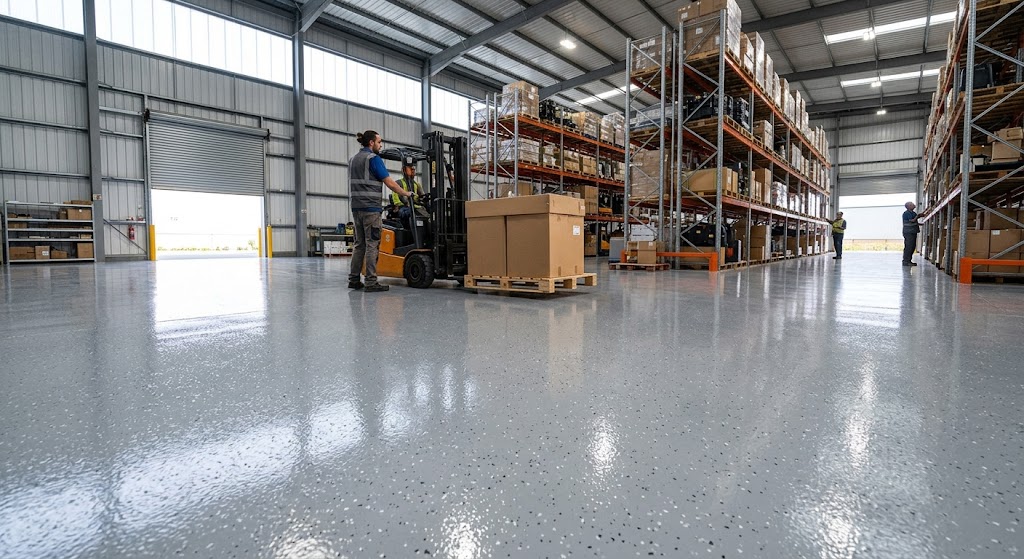
High forklift traffic, heavy pallet loads, and constant movement characterize warehouse environments. Epoxy flooring withstands this abuse while providing the smooth surface needed for efficient material handling. Safety markings for forklift lanes and pedestrian walkways integrate seamlessly.
Manufacturing
Manufacturing facilities deal with chemicals, heavy equipment, and demanding production schedules. Industrial epoxy systems resist the chemical exposure, impact, and abrasion common in these environments.
Food Processing and Commercial Kitchens
Sanitation requirements, frequent washdowns, and chemical exposure define food industry flooring needs. Specialized epoxy and urethane systems provide the seamless, cleanable surfaces required while resisting thermal shock from hot water cleaning.
Automotive Shops
Oil, grease, brake fluid, and antifreeze attack concrete surfaces quickly. Epoxy flooring resists these automotive chemicals while providing an attractive showroom-quality appearance.
Healthcare
Hospitals, clinics, and laboratories require floors that support strict sanitation standards. The seamless, nonporous surface of epoxy flooring prevents bacterial growth and simplifies cleaning protocols.
Retail and Showrooms
Appearance matters in customer-facing environments. Decorative epoxy systems provide attractive, durable surfaces that withstand foot traffic while enhancing the space’s visual appeal.
Parking Garages
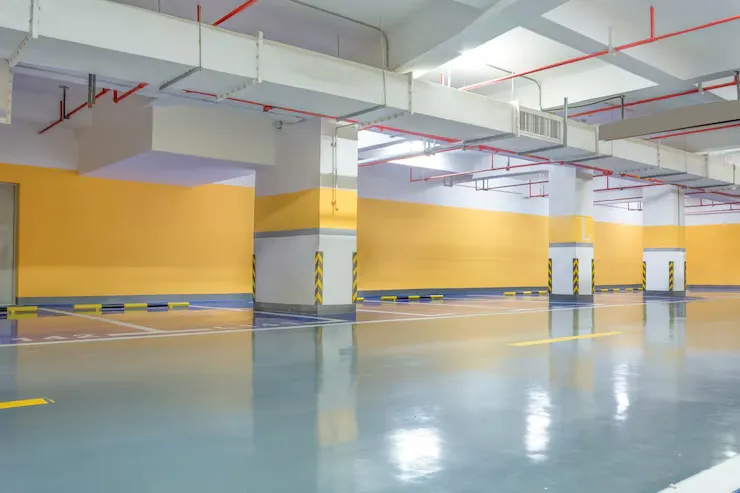
Vehicle traffic, tire abrasion, and chemical exposure challenge parking structure floors. Heavy-duty epoxy systems protect the concrete while improving light reflection and vehicle visibility.
Aircraft Hangars
Jet fuel, hydraulic fluid, and heavy aircraft loads demand exceptional floor performance. Industrial epoxy systems provide the chemical resistance and durability required in aviation environments.
Epoxy Flooring vs Bare Concrete for Workplace Safety
Factor
Bare Concrete
Epoxy Flooring
Slip Resistance
Low when fat
High with anti-slip additives
Chemical Resistance
Poor
Excellent
Cleaning
Difficult due to porosity
Simple and efficient
Dust Generation
Continuous
Eliminated
Durability
Subject to wear and damage
Long lasting protection
Visibility
Light absorption
Reflects light effectively
Maintenance
Frequent repairs needed
Minimal maintenance
Safety
Multiple hazards
Reduce hazards
This comparison helps explain why many facilities choose to coat their concrete surfaces instead of leaving them exposed.
When Standard Epoxy Flooring Falls Short
Epoxy urethane mortar systems address these demanding applications. These heavy-duty coatings can reach a quarter inch or more in thickness, providing exceptional impact resistance and compressive strength. They withstand thermal shock from hot washdowns, resist a broader range of chemicals, and tolerate freeze-thaw cycles that would destroy thinner coatings.
Commercial kitchens, breweries, food processing plants, and heavy manufacturing facilities often require these more durable systems. The investment in a mortar system pays dividends through longer service life and reduced maintenance.
Old Stone Restoration and Installation Corp. installs epoxy urethane mortar systems for facilities requiring greater durability than traditional epoxy flooring. These systems offer special formulations including acid-resistant, freezer-rated, and chemical-resistant options tailored to specific industrial needs.
What are the Key Signs a Workplace Needs a New Epoxy Flooring System?
Over time, even durable concrete floors can start showing signs of wear. Paying attention to these issues early can help prevent bigger problems and maintain a safer, more functional workspace.
Some common signs that your facility may need new epoxy flooring include:
Visible cracks or damage: Cracks in the concrete can create safety hazards and allow moisture to seep into the surface.
Excessive concrete dust: If dust continues to build up even after regular cleaning, the concrete surface may be wearing down.
Slippery surfaces: Floors that become unsafe when wet or after small spills may need a more protective, slip-resistant coating.
Peeling or worn coatings: Chipped, peeling, or faded coatings can leave the concrete underneath exposed to damage.
Standing water issues: Water collecting in low areas may indicate surface problems that need attention.
Chemical stains or damage: Frequent exposure to chemicals can weaken concrete and affect its appearance over time.
Uneven flooring areas: Settlement, heavy use, or long-term wear can create uneven surfaces that impact safety and operations.
Visible forklift or equipment wear: Heavy traffic areas may develop marks, abrasions, or surface breakdown that signal the need for a stronger flooring solution.
Addressing these key signs can help protect your concrete, improve workplace safety, and avoid more costly repairs in the future. Epoxy flooring provides a durable surface designed to handle demanding environments while keeping facilities looking clean and professional.
How Professional Installation Impacts Safety
The quality of installation directly affects how well epoxy flooring performs. Professional epoxy flooring service providers follow processes that ensure long-term success. Professional epoxy flooring installers follow a detailed process to help ensure the coating bonds correctly and performs as expected:
Moisture testing: Before installation begins, professionals check the concrete for excess moisture. Too much moisture beneath the surface can cause issues like bubbling, peeling, or coating failure.
Proper surface preparation: Preparing the concrete is one of the most important steps. Grinding or shot blasting helps remove imperfections, open the surface pores, and create the texture needed for strong adhesion.
Crack and damage repair: Existing cracks, chips, or surface damage should be repaired before applying epoxy. This helps prevent imperfections from showing through the new coating.
Correct coating thickness: Applying the right amount of epoxy is essential for durability. A coating that is too thin may wear down quickly, while professional application helps ensure the system meets performance requirements.
Proper curing conditions: Epoxy needs the right amount of time and conditions to cure properly. Temperature, humidity, and airflow all affect the final strength and finish of the flooring.
Choosing an experienced epoxy flooring professional helps protect your investment and ensures your floor is built to handle everyday wear, traffic, and environmental demands.
How to Choose the Right Epoxy Floor Contractor
Selecting an epoxy floor contractor requires evaluation of several factors.
Experience matters: Contractors with decades of installations have encountered and solved problems that newer companies have not yet faced. Look for proven track records in similar facilities.
References from past clients: This provides insight into reliability, quality, and professionalism. Speak with other businesses in similar industries about their experiences.
Warranty terms: This indicates confidence in workmanship. Understand what is covered and for how long.
Preparation process: Ask specifically about surface preparation methods, moisture testing, and crack repair procedures.
Industrial experience: This ensures the contractor understands the demands of commercial and industrial environments. Residential garage experience does not translate directly to heavy industrial applications.
Materials usage: Either commercial- or industrial-grade products used from reputable manufacturers. Ask about the specific products and their suitability for the application.
Customization options: Every facility has unique requirements that cookie-cutter approaches may not address.
What are the Common Mistakes Businesses Make While Choosing Epoxy Flooring
Several common errors lead to flooring failures and safety problems.
Choosing based only on price: Poor-quality work can lead to peeling, cracks, and early repairs. Businesses should evaluate the installer’s experience and process, not just the cost.
Skipping concrete preparation: Cracks, moisture issues, oil stains, and damaged concrete must be addressed before installation. Applying epoxy over existing problems can cause coating failure.
Using the wrong coating system: A coating designed for light foot traffic may not hold up in warehouses, garages, or industrial facilities with heavy equipment and chemical exposure.
Ignoring slip resistance: Smooth epoxy floors can become slippery when exposed to water, oils, or spills. Adding anti-slip additives helps improve safety in areas where moisture or spills are common.
Neglecting routine maintenance: Epoxy floors are durable but not maintenance-free. Regular cleaning and timely repairs help prevent small issues from becoming larger flooring problems.
Hiring inexperienced installers: Successful epoxy installation depends on proper surface preparation, moisture testing, application techniques, and curing.
Maintenance Tips to Keep Epoxy Flooring Safe
Proper maintenance preserves the safety and appearance of epoxy flooring.
Dirt, dust, and small debris create slip risks when they build up on smooth surfaces. In busy areas like warehouses or manufacturing floors, sweeping twice a day may help prevent scratches and keep walkways clear.
Warm water mixed with a mild detergent works well for most epoxy surfaces. Harsh chemicals and abrasive scrubbers can damage the coating over time, so gentle cleaning products tend to work best.
Walking the floor and looking for chips, scratches, chemical stains, or worn spots takes just a few minutes. Addressing these issues early often prevents more extensive repairs down the road.
An experienced epoxy floor contractor can assess areas that might not be obvious to untrained eyes. Moisture issues beneath the coating, adhesion problems, or wear patterns from heavy equipment all benefit from professional attention.
Liquids sitting on epoxy floors create slip hazards within minutes. Certain chemicals, oils, and solvents can also weaken the coating if left too long. A quick wipe with the right cleaning solution protects both workers and the floor itself.
Consistent maintenance extends the lifespan of any epoxy flooring system while keeping the workplace safer for everyone who walks or drives across it.
Why Experience Matters in Epoxy Flooring Installation
Experienced installers understand how substrate preparation, coating selection, and installation techniques directly affect long-term safety, durability, and performance. They have seen what works and what does not across thousands of projects.
This experience translates into better outcomes for clients. Proper system selection matches the coating to the environment. Thorough preparation ensures adhesion. Quality application techniques produce uniform, durable surfaces.
With more than 35 years of experience in flooring restoration and installation, Old Stone Restoration brings technical knowledge that comes only from decades of hands-on work. This expertise proves especially valuable in challenging environments where standard approaches may not succeed.
Conclusion
Workplace safety starts from the ground up. Damaged concrete, slippery surfaces, and uneven flooring can increase the risk of slips, trips, and falls, affecting both employees and daily operations.
Epoxy flooring provides a safer alternative with a seamless, durable surface that reduces trip hazards and improves traction. Anti-slip additives help in wet areas, while chemical resistance protects floors from oils, solvents, and heavy use. Its reflective finish can also improve visibility in busy workspaces.
Choosing the right epoxy system matters. Standard epoxy works for many commercial spaces, while demanding environments may require stronger systems designed for heavy traffic and chemical exposure.
FAQs
Is epoxy flooring slippery?
Standard glossy epoxy can be slippery when wet. However, anti-slip additives create textured surfaces with excellent traction. Professional installers can customize the level of slip resistance based on the environment and anticipated conditions.
How long does epoxy flooring last?
Properly installed commercial epoxy flooring typically lasts 10 to 20 years depending on traffic levels, chemical exposure, and maintenance practices. Heavy-duty mortar systems may last even longer in demanding environments.
Can epoxy flooring withstand forklift traffic?
Yes, industrial-grade epoxy systems are designed for heavy equipment traffic. The coating provides impact resistance and prevents the surface damage that standard concrete experiences under constant equipment use.
Is epoxy flooring chemical resistant?
Epoxy flooring resists many common chemicals, including oils, greases, and cleaning solutions. For environments with aggressive chemical exposure, specialized formulations such as novolac epoxy or urethane mortars provide enhanced protection.
How long does epoxy flooring installation take?
Installation time varies based on facility size, surface condition, and system complexity. Small projects may be completed in a few days, while large industrial installations could require a week or more. Curing time before returning to full use typically adds several days.
Can damaged epoxy floors be repaired?
Yes, localized damage can often be repaired without replacing the entire floor. Professional assessment determines whether spot repairs will suffice or whether more extensive work is needed.
Is epoxy flooring waterproof?
Epoxy flooring creates a water-resistant barrier that prevents moisture from penetrating the concrete. While not suitable for continuous water immersion, it handles normal spills and washdown procedures effectively.
How much maintenance does epoxy flooring require?
Epoxy flooring requires minimal maintenance. Regular sweeping, periodic mopping with mild detergent, and prompt spill cleanup keep the surface in good condition. An annual professional inspection helps identify issues early.
What industries benefit most from epoxy flooring?
Warehouses, manufacturing facilities, food processing plants, commercial kitchens, automotive shops, healthcare settings, and retail environments all benefit from epoxy flooring. Any facility with heavy traffic, chemical exposure, or strict cleanliness requirements can see improvements.
How do I choose an epoxy flooring contractor?
Look for contractors with extensive experience in commercial and industrial installations, strong references, clear warranty terms, and a thorough approach to surface preparation. Ask about their specific process and the materials they use.
Can epoxy flooring be installed over existing floors?
Epoxy can be applied over existing concrete provided the surface is clean, dry, structurally sound, and free of contaminants. Professional assessment determines whether the existing surface is suitable or requires additional preparation.
What is the difference between epoxy and urethane mortar systems?
Standard epoxy coatings are thinner and suitable for moderate-duty applications. Urethane mortar systems are thicker, heavier-duty coatings designed for extreme conditions including thermal shock, aggressive chemicals, and heavy impact.
A cracked, peeling floor inside a busy warehouse or a dull, stained surface in a car showroom creates problems that go far beyond appearance. The wrong flooring system often leads to expensive repairs, safety hazards, and unexpected business downtime that nobody wants to deal with. Property owners sometimes discover too late that not all epoxy floors perform the same way under real-world working conditions.
Old Stone Restoration and Installation Corp has installed and restored high-performance flooring systems for over 35 years across Long Island, helping property owners choose solutions based on real-world performance rather than marketing claims alone.
Quick Answer:
The best epoxy flooring system depends on how the floor will be used daily. Self-leveling epoxy works well for showrooms and retail spaces, while epoxy mortar systems handle heavy industrial environments. Decorative flake systems suit residential garages well, and high-build epoxy coatings perform excellently in warehouses. Working with a professional epoxy flooring service ensures maximum durability, proper surface preparation, and long-term value for any project.
What Are Epoxy Flooring Systems?
Epoxy flooring systems consist of two main components: epoxy resin and a chemical hardener. When mixed together, these components create a chemical reaction that bonds directly to concrete surfaces, forming a seamless, protective coating that becomes extremely tough once fully cured.
The basic installation process follows this pattern:
Unlike regular floor paint that sits on top of concrete, epoxy actually penetrates and bonds with the surface below. This delivers industrial-grade performance for handling heavy equipment, chemical spills, and constant foot traffic without breaking down quickly.
The curing process typically takes several days to reach full strength. During this time, the floor transforms from a liquid coating into a rock-hard protective layer that can last for many years with proper care.
Why is Epoxy Flooring Popular?
Facility managers and property owners continue to choose epoxy flooring for several practical reasons that make daily operations easier.
The seamless surface eliminates cracks and joints where dirt, bacteria, and liquids tend to collect. Cleaning becomes much simpler because there are no grout lines or seams to scrub. A quick sweep and occasional mop usually keep epoxy floors looking great.
Chemical resistance stands out as another major benefit. Oil spills, cleaning solutions, and industrial chemicals that would destroy regular concrete often wipe right off epoxy surfaces without leaving permanent stains or damage.
The dust-free nature helps facilities that require clean air. Unlike bare concrete that constantly releases fine particles, sealed epoxy floors stay smooth and contained. This matters especially in healthcare settings, food processing areas, and electronics manufacturing.
Heavy-traffic areas benefit from exceptional durability. Forklifts, pallet jacks, and constant foot traffic that would wear down other flooring materials barely affect quality epoxy installations. According to the Flooring Contractors Association, properly installed commercial epoxy systems can handle over 10,000 pounds per square inch of compressive strength.
Self-leveling epoxy creates a perfectly smooth, glossy surface that looks almost like glass when finished. The liquid mixture spreads across floors and naturally levels itself, filling in minor imperfections and creating a seamless appearance.
Best Applications: Showrooms, retail stores, offices, commercial interiors, and spaces where appearance matters as much as durability.
Advantages: Creates stunning visual appeal, reflects light beautifully, easy to clean, available in many colors, and provides moderate chemical resistance.
Epoxy Mortar Flooring
Epoxy mortar systems represent the toughest option available. These systems combine epoxy resin with sand or quartz aggregate, creating a thick, incredibly strong surface that handles the most demanding industrial conditions.
For facilities requiring maximum durability, professionally installed Epoxy and Urethane Mortars provide outstanding resistance to heavy traffic, chemicals, and impacts while significantly extending the life of concrete floors.
Best Applications: Manufacturing plants, warehouses with heavy equipment, food processing facilities, and areas with forklift or steel wheel traffic.
Advantages: Exceptional impact resistance, handles thermal shock, repairs damaged concrete effectively, and provides the highest compressive strength available.
High Build Epoxy Coating
High-build systems apply coatings thicker than standard, typically ranging from 10 to 20 mils. This extra thickness provides better protection against abrasion and chemical exposure while still maintaining a smooth, attractive finish.
Best Applications: Warehouses, distribution centers, industrial buildings, and facilities needing enhanced protection without the heaviest mortar systems.
Advantages: Good balance between cost and performance, handles moderate to heavy traffic, and provides excellent chemical resistance.
Decorative Flake Epoxy
Decorative flake systems broadcast colored vinyl or acrylic chips into wet epoxy, creating a textured, multicolored appearance that hides imperfections and adds slip resistance.
Best Applications: Residential garages, auto repair shops, home workshops, and commercial spaces wanting decorative appeal with good performance.
Advantages: Hides minor floor damage, adds texture for better traction, offers countless color options, and provides good durability for moderate traffic.
Metallic Epoxy Flooring
Metallic epoxy contains special pigments that create unique, three-dimensional effects resembling marble, lava flow, or artistic swirls. Each installation looks different because the metallic particles move during application.
Best Applications: Luxury garages, car showrooms, hotels, high-end retail, and anywhere that wants to make a dramatic visual statement.
Advantages: Creates truly unique, eye-catching floors, reflects light beautifully, provides good durability, and adds significant property value in the right settings.
Quartz Epoxy Flooring
Quartz-filled epoxy systems use colored quartz granules to create a decorative, textured surface with excellent slip resistance, even when wet.
Best Applications: Hospitals, schools, locker rooms, commercial kitchens, restrooms, and areas needing both safety and aesthetics.
Advantages: Superior slip resistance, decorative appearance, good chemical resistance, and handles moisture well.
Comparison Table: Epoxy Flooring Systems at a Glance
Flooring System
Best for
Durability
Appearance
Maintenance
Self Leveling
Showrooms, Offices
Moderate
Excellent
Low
Epoxy Mortar
Heavy Industry
Very high
Moderate
Low
High Build
Warehouses
High
Good
Low
Decorative Flake
Garages, Workshops
Moderate
Good
Low
Metallic
Luxury Spaces
Moderate
Excellent
Moderate
Quartz
Schools, Kitchens
High
Good
Low
Best Epoxy Flooring Systems for Warehouses
Warehouses deal with heavy traffic, constant equipment movement, spills, and regular wear. The right epoxy flooring system should be able to handle all of this.
For moderate traffic: High-build epoxy coatings offer strong protection for warehouses with lighter equipment and regular foot or forklift traffic.
For heavy-duty use: Epoxy mortar systems are better suited for warehouses with heavy forklift traffic, steel-wheeled traffic, dropped loads, and other demanding conditions.
For cold storage areas: Epoxy mortar flooring can handle temperature fluctuations and thermal shock better than many standard coatings.
For chemical and oil spills: Quality epoxy systems help protect the concrete from hydraulic fluid, fuel, oil, and cleaning chemicals.
For extra protection: A polyurethane topcoat can increase resistance to chemicals, UV exposure, and everyday wear.
For impact and abrasion resistance: Heavy-duty epoxy flooring can withstand dropped pallets, equipment impacts, and constant forklift traffic.
Best Epoxy Flooring Systems for Garages
Home garages deal with hot tires, oil leaks, chemical spills, and regular vehicle traffic. The right epoxy system should offer durability while also matching the space’s look and use.
Decorative flake epoxy: It remains a popular choice for residential garages. The flakes can help hide minor stains and imperfections while adding texture and slip resistance.
Metallic epoxy: Creates a more decorative, custom look. Its unique patterns can give a garage a high-end appearance, although it usually costs more and requires more precise installation.
Professional installation: can make a noticeable difference in how well the flooring performs. DIY kits may work for some projects, but proper surface preparation and application are important for long-term results.
Hot tire pickup: This is a common problem with poorly prepared or improperly installed epoxy floors. Hot tires can stick to the coating and pull it away from the concrete. Using high-quality materials and properly preparing the concrete can help reduce this risk.
Best Epoxy Flooring Systems for Garages
A home garage has its own flooring challenges. Hot tires, oil drips, vehicle traffic, and the occasional chemical spill can all take a toll on a concrete floor over time. Epoxy flooring can help protect the surface while also giving the garage a cleaner, more finished look.
Decorative flake epoxy: The flakes help hide small stains and imperfections while adding texture to the floor. With various colors and patterns available, the finish can also be matched to the garage’s overall look.
Metallic epoxy: This offers a more custom appearance, with patterns that give the floor a unique, almost artistic finish. It can be a popular option for car enthusiasts who want their garage to feel more distinctive.
Professional installation: DIY kits may seem convenient, but surface preparation is one of the most important parts of the process. Professional installers have the tools and experience needed to properly prepare the concrete and apply the coating.
Hot-tire pickup: When hot tires stick to the coating, they can pull it away from the concrete. Proper surface preparation, quality materials, and correct application can help reduce the risk of this happening.
Best Epoxy Flooring Systems for Showrooms
In a showroom, the epoxy flooring system does more than cover the concrete. It helps set the tone for the entire space and can influence how customers view the products on display.
Self-leveling epoxy: It creates a smooth, seamless surface that reflects light evenly and gives the showroom a clean, polished appearance.
High-gloss finish: This can make the space feel brighter and help product colors stand out. However, scratches and marks may be more noticeable in busy showrooms.
Semi-gloss finish: This offers a balance between appearance and practicality, especially in spaces with regular foot traffic.
Metallic epoxy: This can add a more distinctive look to luxury car dealerships, high-end retail spaces, and other showrooms where the floor itself is part of the design.
Lighting: The color and finish of the epoxy can affect how overhead lights reflect across the floor and how products appear in the space. A professional installer can help recommend a finish that works well with the showroom’s lighting and overall design.
How to Choose the Right Epoxy Flooring System?
Selecting the correct epoxy flooring services requires an honest assessment of several key factors that affect long-term performance.
Traffic Patterns: Consider both the type and amount of traffic the floor will handle. Foot traffic only? Forklifts? Pallet jacks? Steel wheel carts? Each traffic type demands different performance characteristics.
Budget Considerations: While cheaper systems save money initially, they often cost more over time through earlier replacement and more frequent repairs. Mid-range to premium systems generally provide better value over a facility’s lifespan.
Moisture Conditions: Some facilities have moisture vapor transmission through concrete slabs. This moisture can cause epoxy to bubble, peel, and fail prematurely. Proper moisture testing during preparation identifies potential problems before installation begins.
UV Exposure: Areas with significant sunlight exposure need UV-stable topcoats to prevent yellowing and fading. Aliphatic polyurethane topcoats handle UV exposure much better than standard epoxy.
Chemical Exposure: Identify which chemicals will regularly come into contact with the floor. Different epoxy formulations resist different chemicals. Manufacturing facilities handling acids need specialized formulations that general-purpose epoxy cannot match.
Desired Appearance: Aesthetic requirements vary widely between applications. Industrial warehouses need function over form, while showrooms prioritize visual appeal. Match the system to actual appearance needs.
Downtime Tolerance: Installation and curing take time. Some facilities cannot shut down for extended periods. Polyaspartic and urethane systems cure faster than traditional epoxy, which may matter for time-sensitive projects.
Expected Lifespan Goals: Planning to use the space for five years differs from twenty-year projections. Investment levels should match how long the flooring needs to perform.
Epoxy Flooring vs Other Flooring Options
Understanding how epoxy compares to alternatives helps property owners make informed decisions about their specific situations.
Polished Concrete: Creates attractive, durable floors by grinding and polishing existing concrete. Works well in retail and commercial spaces. Polished concrete costs less than epoxy but does not offer the same chemical resistance or seamless protection.
Polyurethane Coatings: More flexible than epoxy and handle UV exposure better. Often used as topcoats over epoxy base layers. Standalone polyurethane systems work well for floors that need chemical resistance and some flexibility.
Polyaspartic Coatings: Cure much faster than traditional epoxy, sometimes in just a few hours. This speed advantage helps facilities that cannot tolerate extended downtime. Performance rivals good epoxy systems in many applications.
Tile Flooring: Traditional tiles work in some commercial settings but create grout lines that collect dirt and bacteria. Impact resistance is generally poorer than that of seamless epoxy systems.
Vinyl Flooring: Lower-cost option for light-duty commercial applications. Vinyl cannot handle heavy equipment or industrial conditions, but it works well for offices and light retail.
Concrete Paint: Concrete paint wears quickly under traffic and provides little chemical resistance. Most facilities outgrow paint quickly and eventually upgrade to proper epoxy systems. The cheapest option, but it offers minimal protection.
Surface Preparation: The Step That Makes the Difference
A durable epoxy floor starts with properly prepared concrete. Even high-quality epoxy can fail if the surface is not ready for the coating.
Grinding or shot blasting removes the smooth surface and creates the texture epoxy needs to bond properly.
Crack repair fixes existing damage before the coating is applied, helping prevent cracks from showing through the finished floor.
Moisture testing checks for excess moisture in the concrete. If moisture levels are too high, the issue may need to be addressed before installation.
Deep cleaning removes oil, grease, dirt, old coatings, and other contaminants that could prevent the epoxy from bonding properly.
Primer application helps create a stronger bond between the concrete and the epoxy system. The right primer depends on the condition of the concrete and the type of flooring being installed.
Taking the time to properly prepare the surface can help prevent common problems such as peeling, bubbling, and delamination. This step may take extra time, but it plays a major role in how well the finished floor performs over the long term.
Professional Epoxy Flooring Service vs DIY Installation
Factor
Professional Service
DIY Installation
Initial Cost
Higher
Lower
Dyrability
Excellent
Variable
Warranty
Generally, yes
Usually none
Equipment
Industrial grade
Consumer grade
Safety
Handled by experts
Personal responsibility
Finish quality
Consistent, professional
Depends on skill
Time required
Faster completion
Extended timeline
Surface prep
Thorough, proper
Often inadequate
DIY garage kits appeal to budget-conscious homeowners, and some achieve acceptable results. However, professional epoxy flooring services typically yield floors that last significantly longer and perform better in actual use.
Industrial and commercial applications almost always require professional epoxy flooring installation. The stakes are too high and the square footage too large for DIY approaches to make practical sense.
What are the Common Epoxy Flooring Mistakes That Usually Happen?
Understanding common mistakes helps property owners avoid them and ask better questions when hiring contractors.
Wrong Product Selection: Using residential-grade products for commercial applications leads to premature failure. Matching product capabilities to actual use requirements matters enormously.
Skipping Proper Grinding: Surface preparation shortcuts cause more failures than any other single mistake. There is no substitute for proper mechanical preparation.
Applying Over Moisture: Concrete that looks dry may still contain moisture vapor that causes problems. Testing moisture levels before application prevents expensive failures.
Poor Mixing: Epoxy resin and hardener require precise mixing ratios and thorough blending. Improper mixing creates soft spots, discoloration, and adhesion problems.
Incorrect Curing Conditions: Temperature and humidity affect how epoxy cures. Installing during inappropriate weather conditions compromises the final result.
Cheap Materials: Budget materials save money initially but cost more over the floor’s lifespan through earlier replacement and more maintenance issues.
Inexperienced Installers: Epoxy installation requires specific skills that develop with practice. Inexperienced crews make mistakes that compromise quality even when using premium materials.
How Long Do Epoxy Flooring Systems Last?
Lifespan varies significantly based on installation quality, traffic levels, and maintenance practices.
Residential Applications: Quality garage epoxy typically lasts 10 to 20 years with normal use and basic maintenance. Higher traffic or heavy equipment use shortens this range.
Commercial Applications: Well-installed commercial epoxy systems typically last 15 to 25 years in moderate-traffic environments. High-traffic retail or office spaces may need resurfacing sooner.
Industrial Applications: Heavy industrial mortar systems can last over 20 years, even under demanding conditions, when properly installed and maintained. Some facilities report 30+ years of quality installations.
Maintenance Schedules: Regular cleaning, prompt spill cleanup, and periodic inspections significantly extend the floor’s lifespan. Neglected floors degrade faster regardless of initial quality.
Resurfacing Timing: When wear becomes noticeable, but the base coating remains sound, resurfacing with a fresh topcoat often restores appearance and protection without complete replacement.
Maintenance Tips for Epoxy Floors
Daily Care: Sweep or dust-mop to remove grit and debris that could scratch surfaces under foot traffic. This simple step prevents most wear patterns.
Weekly Cleaning: Damp-mop with clean water or a mild detergent solution. Avoid harsh chemicals and abrasive cleaning tools that could damage the surface.
Monthly Attention: Inspect for any developing problems, such as cracks, chips, or peeling edges. Addressing small issues early prevents them from becoming major repairs.
Annual Inspection: Walk the entire floor looking for wear patterns, chemical damage, or structural issues. Professional inspection may identify problems that untrained eyes miss.
Proper maintenance extends floor life dramatically while keeping surfaces looking professional. The small time investment pays significant dividends through avoided repairs and extended replacement timelines.
Key Signs It Is Time to Replace or Restore Epoxy Floors
Several warning signs indicate when floors need professional attention.
Peeling or Bubbling: When epoxy separates from concrete, adhesion has failed. Small peeling areas may allow spot repairs, but widespread peeling usually requires complete removal and reinstallation.
Visible Cracks: Surface cracks that penetrate through the coating allow moisture and chemicals to reach concrete below. Cracks should be addressed before they worsen.
Discoloration: Yellowing, fading, or uneven color changes indicate UV damage or chemical exposure. While primarily cosmetic, discoloration may signal deeper material degradation.
Delamination: Layers separating from each other compromise the entire system. Delamination typically spreads over time if not addressed.
Deep Scratches: Surface scratches in high-traffic paths expose underlying layers to wear. Heavy scratch patterns indicate the floor has exceeded its service life.
Chemical Damage: Etching, softening, or discoloration caused by chemical exposure may require recoating or replacement, depending on severity.
Why Hiring an Experienced Epoxy Floor Contractor Matters
Experience translates directly into better flooring results. Contractors who have completed hundreds or thousands of projects understand how different conditions affect outcomes. They recognize potential problems before they become expensive failures.
Correct material selection requires understanding how different products perform under various conditions. Experienced contractors match materials to actual use requirements rather than defaulting to familiar products.
Moisture testing and proper substrate preparation eliminate the most common causes of failure. Professional equipment and testing protocols identify issues that visual inspection cannot detect.
Industrial preparation equipment achieves surface profiles that consumer tools cannot match. Diamond grinders, shot blasters, and professional vacuum systems create ideal bonding conditions.
With more than 35 years of experience, Old Stone Restoration and Installation Corp. understands that every facility has different flooring requirements. Whether installing decorative garage coatings or heavy-duty industrial epoxy systems, selecting the correct flooring system matters just as much as the installation itself.
Why Choose Old Stone Restoration and Installation Corp.
35+ Years of Experience: Serving property owners across Long Island with decades of hands-on knowledge.
Commercial and Residential Projects: Flooring solutions for projects of all sizes and property types.
Industrial Epoxy Systems: Durable flooring options designed for demanding environments.
Decorative Finishes: Stylish options for garages, showrooms, and other spaces.
Professional Surface Preparation: Proper equipment and preparation techniques to support long-lasting results.
Quality Materials: Premium products sourced from trusted manufacturers.
Long-Term Performance: Flooring solutions designed to handle everyday wear and demanding use.
Customized Solutions: Recommendations tailored to each property’s specific needs.
With decades of hands-on experience, the team at Old Stone Restoration and Installation Corp. understands what goes into preparing and installing a floor that performs well. Proper planning and preparation can also help property owners avoid common issues and unnecessary repair costs.
For heavy-duty flooring applications, explore the Epoxy and Urethane Mortars to learn more about industrial-grade systems designed for demanding environments.
Conclusion
The best epoxy flooring system depends on the space, the amount of traffic it sees, and the type of wear the floor needs to withstand. A busy warehouse may need a heavy-duty system, while a home garage or showroom may benefit from a different finish and level of protection.
If planning a new epoxy flooring project or upgrading worn concrete floors, working with an experienced epoxy floor contractor helps ensure the flooring system matches specific property requirements.
The best system depends on specific application needs. Epoxy mortar handles heavy industrial use, self-leveling works well for showrooms, and decorative flake systems suit most residential garages.
Which epoxy system works best for warehouses?
High-build epoxy coatings or epoxy mortar systems typically perform best in warehouse environments. These systems handle forklift traffic, heavy loads, and chemical exposure better than thinner coatings.
What is the best garage epoxy floor?
Decorative flake epoxy systems remain the most popular choice for residential garages, offering good durability, attractive appearance, and slip resistance at reasonable cost.
Is epoxy flooring good for commercial buildings?
Yes, epoxy performs exceptionally well in commercial settings, including retail stores, offices, restaurants, and healthcare facilities, when the right system is selected for the specific conditions.
How long does epoxy flooring typically last?
Quality installations commonly last 10 to 25 years depending on traffic levels, maintenance practices, and the specific system installed. Industrial mortar systems may last for more than 20 years.
Is epoxy flooring waterproof?
Properly installed epoxy creates a waterproof barrier that prevents liquids from penetrating into concrete below. However, moisture vapor from beneath the slab can cause problems if not addressed during installation.
Does epoxy flooring crack over time?
Epoxy itself rarely cracks, but if the concrete substrate cracks, those cracks may telegraph through the coating. Proper crack repair during preparation prevents most issues.
Can epoxy be applied over old concrete?
Yes, epoxy bonds well to properly prepared existing concrete. Surface preparation including cleaning, grinding, and crack repair ensures good adhesion to older slabs.
Is metallic epoxy durable enough for regular use?
Metallic epoxy provides moderate durability suitable for showrooms, luxury garages, and light commercial applications. Heavy industrial use typically requires different systems.
Can forklifts damage epoxy floors?
Standard epoxy coatings can be damaged by forklift traffic over time. Heavier epoxy mortar systems and high-build coatings handle forklift traffic much better.
How thick should epoxy flooring be?
Thickness varies by system and application. Standard coatings run 2 to 3 mils, high-build systems reach 10 to 20 mils, and mortar systems can exceed 1/4 inch, depending on requirements.
Is professional installation worth the extra cost?
For most applications, professional installation delivers significantly better long-term value through proper preparation, appropriate material selection, and longer-lasting results.
How much maintenance does epoxy require?
Epoxy floors require minimal maintenance. Regular sweeping and occasional damp mopping keep most floors in excellent condition for many years.
What is the difference between epoxy and urethane mortar systems?
Urethane mortars offer better thermal shock resistance and flexibility compared to epoxy mortars. Urethane systems work better in areas with temperature swings or hot wash-down cleaning.
Which epoxy flooring system looks best in showrooms?
Self-leveling epoxy and metallic epoxy systems create the most visually impressive showroom floors. Both offer high gloss finishes that enhance product displays and customer impressions.
Cracked concrete often feels like a dealbreaker. Many homeowners and business owners look at the lines running across their garage floor or warehouse slab and assume the only option is to tear everything out and start fresh. That assumption can lead to unnecessary expense and frustration.
Most concrete cracks are repairable, and epoxy floor installation can be directly applied over them once the surface is properly prepared. The key lies in understanding what type of crack exists, whether it is still moving, and how deep the damage goes.
With over 35 years of experience, Old Stone Restoration and Installation Corp. has restored and coated concrete surfaces ranging from residential garages to commercial facilities across Long Island. That kind of hands-on knowledge matters when dealing with cracked concrete.
Quick Answer:
Yes, epoxy flooring can be installed over cracked concrete in most cases. Small cracks and surface cracks can usually be repaired before the epoxy is applied. However, large cracks, moving cracks, or cracks caused by foundation problems should be fixed first. When the concrete is properly repaired and prepared, epoxy flooring creates a strong, smooth, and long-lasting surface for garages, basements, warehouses, and other spaces.
According to the Portland Cement Association, understanding crack type and movement is essential before applying any protective coating (PCA – Concrete Crack Evaluation).
Coating over moving cracks often leads to failure, while dormant cracks typically accept repairs and coatings without issue.
Here is a quick reference for common crack types:
Crack Type
Can Epoxy Be Installed?
Hairline Crack
Yes
Shrinkage Crack
Yes
Surface Crack
Yes
Settlement Crack
Sometimes
Structural Crack
Requires repair first
Active or Moving Crack
This is not recommended until stabilized
Fresh concrete contains water. As that water evaporates during the curing process, the slab shrinks slightly. This shrinkage can create fine cracks that appear within the first few months after pouring.
Heavy Vehicle Traffic
Garages, warehouses, and industrial floors endure constant weight from vehicles, forklifts, and heavy equipment. Over time, this repeated stress can cause surface cracking, especially in areas where the concrete was poured too thin or without proper reinforcement.
Soil Movement and Settlement
The ground beneath the concrete is not always stable. Clay soils expand when wet and shrink when dry. This movement can cause the overlying slab to shift, leading to cracks at weak points.
Moisture Changes
Water seeping under a slab can erode the supporting base material. When that support disappears, sections of concrete may sink or crack under normal use.
Freeze Thaw Cycles
In colder climates like Long Island, water trapped in concrete pores expands when it freezes. Repeated freeze-and-thaw cycles can cause surface spalling and deeper cracking over multiple winters.
Poor Original Installation
Concrete mixed with too much water, poured over improperly compacted soil, or cured too quickly tends to develop cracks earlier than properly installed slabs.
Which Cracks Are Safe for Epoxy Flooring Installation?
Hairline Cracks
These tiny lines are usually cosmetic. They rarely compromise structural integrity and respond well to simple crack filling prior to epoxy application.
Minor Surface Cracks
Common in older epoxy garage floors, these shallow cracks typically stay stable over time. After cleaning and filling, they make excellent candidates for epoxy coating.
Dormant Cracks
Industry guidance commonly notes that dormant or static cracks can be repaired and coated successfully when properly prepared. If a crack has not changed in size or shape over several months, it is likely dormant and ready for treatment.
Which Cracks Need Professional Repair Before Epoxy Flooring?
Structural Cracks
Wide cracks that run deep into the slab may indicate foundation issues. These require evaluation by a qualified professional before any coating work begins.
Wide Cracks
Cracks wider than a quarter inch often need more than simple filling. Epoxy mortar or specialized repair compounds may be necessary to restore surface integrity.
Active Cracks
If a crack is still moving due to ongoing soil settlement or structural stress, coating over it will only hide the problem temporarily. The crack will likely reappear through the epoxy layer.
Foundation Related Cracks
Cracks that appear near load-bearing walls or in patterns suggesting foundation movement need structural attention first.
Moisture-Damaged Concrete
Concrete that stays damp, shows efflorescence, or has visible water intrusion often indicates drainage problems that must be resolved before epoxy installation.
Important Note: Applying epoxy directly over moving cracks can result in visible cracking, peeling, or delamination later. Proper repair and stabilization must happen first.
How Professionals Repair Cracked Concrete Before Installing Epoxy Flooring
This step-by-step process separates professional epoxy flooring service from quick DIY attempts that often fail within a year or two.
Step 1: Detailed Concrete Inspection
A thorough walkthrough identifies all cracks, spalled areas, and potential problem spots. This inspection determines what repairs are needed and whether the slab can support an epoxy coating.
Step 2: Moisture Testing
Excess moisture trapped in concrete causes epoxy to fail. Professional installers test moisture levels to ensure proper adhesion.
Step 3: Crack Cleaning
Cracks must be free of dust, debris, and loose material before repair compounds can bond properly. Wire brushing, vacuuming, and sometimes pressure washing accomplish this.
Step 4: Crack Filling
Depending on crack width and depth, professionals use epoxy fillers, polyurea compounds, or cementitious repair materials. Each product serves a different purpose.
Step 5: Surface Grinding
Diamond grinding removes the top layer of concrete, opening pores and creating a profile that allows epoxy to bond mechanically with the slab.
Step 6: Surface Profiling
The concrete surface needs a specific texture for optimal adhesion. Too smooth and the coating will not stick. Too rough and coverage becomes uneven.
Step 7: Final Epoxy Application
Multiple coats build up the final floor system. A primer coat penetrates the surface, followed by the body coat and a protective topcoat.
Professional installers typically repair cracks and mechanically prepare the slab before coating to improve adhesion and durability.
Will Cracks Show Through Epoxy Flooring?
This question comes up frequently, and the honest answer depends on several factors.
Repaired Hairline Cracks: Properly filled hairline cracks typically disappear completely under quality epoxy flooring. The repair material and coating create a seamless appearance.
Improperly Repaired Cracks: Cracks filled with the wrong material or without proper cleaning may show through or telegraph to the surface over time.
Moving Cracks: Real-world installers and users frequently note that movement joints and active cracks may remain visible or reappear over time because the concrete beneath the coating continues to move.
Control Joints: Intentional grooves cut into concrete to control where cracks form will typically remain visible through epoxy. Many property owners choose to fill these joints with a flexible sealant that allows continued movement without damaging the coating.
Can Epoxy Flooring Prevent Future Concrete Damage?
Once installed over properly prepared concrete, epoxy flooring service offers several protective benefits.
Chemical Resistance: Oil, gasoline, brake fluid, and common household chemicals sit on the surface rather than soaking into the concrete below.
Moisture Protection: A sealed epoxy surface prevents water penetration that can cause freeze-thaw damage or erosion of the underlying slab.
Abrasion Resistance: Heavy traffic, dropped tools, and dragged equipment cause less damage to epoxy-coated floors than bare concrete.
Easier Maintenance: Smooth epoxy surfaces clean quickly with regular sweeping and occasional mopping. Stains that would permanently mark bare concrete wipe away easily.
Improved Lifespan: By protecting concrete from the elements and daily wear, epoxy coating can extend a slab’s service life by many years.
What are the Key Signs your Concrete is too damaged for Epoxy Flooring?
Sometimes, concrete damage goes beyond what repair and coating can address.
Severe Structural Movement: Large sections of floor that have shifted significantly may need removal and replacement rather than repair.
Extensive Spalling: When large areas of concrete surface are flaking, the slab may lack the structural integrity needed to support an epoxy coating.
Major Foundation Problems: Cracks accompanied by bowing walls, sticking doors, or visible settlement indicate foundation issues that require structural repair before any cosmetic work.
Continuous Moisture Intrusion: Concrete that stays wet despite drainage improvements may need waterproofing treatment or slab replacement.
Large Uneven Sections: Sections of the floor that have sunk by more than an inch or two may require mudjacking or slab replacement to restore a level surface.
Residential Areas Where Epoxy Flooring Works Well Over Repaired Concrete
Garage Floors: The most common residential application. Garage floors endure vehicle traffic, chemical spills, and temperature swings that epoxy handles well.
Basements: Properly treated basement floors become usable living space or storage areas protected from moisture and dust.
Patios: Exterior-rated urethane systems protect outdoor concrete from weather while adding visual appeal.
Utility Rooms: Laundry rooms and mechanical spaces stay cleaner and more organized with coated floors.
Commercial Spaces That Benefit from Epoxy Flooring
Warehouses: Heavy forklift traffic and constant product movement demand the durability that epoxy mortar systems provide.
Manufacturing Facilities: Chemical resistance and easy cleaning make epoxy ideal for production environments.
Retail Spaces: Attractive metallic garage floor or quartz broadcast systems create welcoming customer environments while withstanding foot traffic.
Restaurants: Commercial kitchen floors require sanitary, slip-resistant surfaces that meet health code requirements.
Automotive Facilities: Service bays and showrooms both benefit from chemical-resistant, easy-clean epoxy surfaces.
Why Hiring a Professional Epoxy Flooring Service Matters
Surface preparation equipment, crack assessment expertise, moisture testing capabilities, proper repair products, and application experience all contribute to long-term durability. Skipping any of these steps can lead to coating failure within months.
With 35 years of hands-on restoration and flooring experience, Old Stone Restoration and Installation Corp. understands how to evaluate cracked concrete and recommend the professional epoxy flooring solution for long-lasting results.
Why Choose Old Stone Restoration & Installation Corp for Epoxy Flooring?
Old Stone Restoration & Installation Corp brings 35 years of hands-on experience in concrete floor installation, restoration, and coating systems to every project. That depth of experience translates into correct product selection, proper surface preparation, and finished floors that hold up over time.
Residential and commercial expertise spans a wide range of project types and environments. The epoxy flooring service team has access to industrial-grade epoxy and urethane mortar systems not available through retail channels. Comprehensive surface preparation includes diamond grinding, moisture testing, and crack repair for every job.
Customized flooring solutions get matched to the specific demands of each space. A long-term performance focus prioritizes durability over quick, inexpensive shortcuts that fail within a few years.
Conclusion
Yes, epoxy flooring can be installed over cracked concrete in most situations. The key is proper inspection, accurate crack identification, and thorough surface preparation before any coating is applied.
Skipping preparation steps or coating over active cracks typically leads to peeling, visible crack lines, and premature failure. Taking the time to do it right the first time saves money and frustration down the road.
Old Stone Restoration & Installation Corp has installed and restored concrete floors for over 35 years, bringing the same standard of preparation and product quality to every project, regardless of size. Whether the project calls for a standard residential garage floor coating or an industrial-grade epoxy urethane mortar system built to withstand the toughest conditions, the team delivers floors that perform and last.
Contact Old Stone Restoration & Installation Corp. today to discuss the right epoxy flooring system for the project. Call (631) 821-5619 to request a consultation.
FAQs
Can epoxy flooring cover cracks completely?
Most hairline and minor surface cracks become invisible after proper filling and epoxy application. Larger or moving cracks may remain visible or reappear over time.
How large can a crack be before epoxy installation?
Cracks up to a quarter inch wide typically respond well to standard repair methods. Wider cracks may need epoxy mortar or specialized repair before coating.
Will cracks come back after epoxy flooring?
Dormant cracks that are properly repaired rarely reappear. Active cracks that continue to move may eventually telegraph through the coating.
Do I need to repair the cracks in the garage floor before applying epoxy?
Yes. Skipping crack repair often leads to coating failure. Even small cracks should be cleaned and filled before application.
How long does crack repair take?
Most residential crack repairs require 1 day to fill and cure before epoxy application can begin.
Is epoxy flooring better than replacing concrete?
In most cases involving repairable damage, epoxy coating over repaired concrete costs significantly less than full slab replacement while providing excellent results.
Garage floors take a beating. Between oil drips, tire scuffs, cracking slabs, and moisture pushing up from below, an uncoated concrete floor deteriorates faster than most homeowners expect. Once the surface starts breaking down, loose concrete dusts everything in the space and cleaning becomes a losing battle.
That is where epoxy garage floor paint changes the situation. A properly installed epoxy coating bonds directly to the concrete, sealing the surface against chemicals, moisture, and abrasion. It transforms a worn slab into a clean, durable floor that is far easier to maintain.
At Old Stone Restoration & Installation Corp, we have over 35 years of experience installing epoxy flooring systems for residential, commercial, and industrial properties across Long Island and the greater New York area. Through decades of hands-on work, our team has tested numerous coating systems and understands which products perform best in real-world environments. This guide covers the five best garage floor epoxy paints available in 2026, what separates them, and when a professional installation makes more sense than a store-bought kit.
Why Garage Floors Fail
Concrete is strong under compression but porous. Without a protective coating, several forces attack the surface over time:
Oil and gasoline stains penetrate deep into the concrete, leaving permanent discoloration and weakening the surface layer.
Hot tire marks transfer chemicals from rubber compound onto the floor, leaving sticky residue that lifts paint from poorly bonded coatings.
Hairline cracks develop from freeze-thaw cycles and slab settlement, allowing moisture to enter and widen the damage.
Moisture vapor rising through the slab pushes coatings up from underneath, causing bubbling and delamination that no topcoat can fix without proper prep.
Epoxy coatings address all of these problems when installed correctly. The key word is correct. Surface preparation determines whether an epoxy system lasts 15 years or peels within 18 months.
Quick Comparison Table of the Best Garage Floor Epoxy Paints
Brand
Best For
Durability
DIY Friendly
Professional Grade
Rust-Oleum EpoxyShield
Home Garages
4/5
Yes
No
Rust-Oleum RockSolid Polycuramine
Heavy Use
5/5
Yes
Semi-Pro
ArmorPoxy
Commercial Use
5/5
Moderate
Yes
Epoxy-Coat
DIY Projects
4/5
Yes
No
Colored Epoxies 100% Solids
Professional Installations
5/5
No
Yes
What Makes a Good Garage Floor Epoxy Paint?
Epoxy is a family of thermosetting polymers formed by reacting a resin with a hardening agent. When the two components cure, they cross-link into a tough, chemically resistant film that bonds tightly to concrete. For more on the underlying chemistry, the Wikipedia article on epoxy provides a thorough overview. Not every product marketed as garage floor epoxy performs the same. When evaluating options, these five characteristics matter most.
Chemical Resistance
A quality epoxy coating resists oil, gasoline, and brake fluid without softening or staining. Floors in active garages will contact all three. Products with lower solids content tend to absorb these chemicals over time, leading to discoloration and surface breakdown.
Hot Tire Resistance
Standard latex floor paints fail under hot tires because the rubber compound chemically bonds to the coating as it cools. True epoxy systems cure into a harder film that resists this transfer. Polycuramine and 100% solid epoxy systems offer the strongest performance in this category.
Abrasion Resistance
Daily foot traffic, rolling toolboxes, and vehicle tires all wear the surface. Measured by mil thickness after cure, higher solids content coatings leave a thicker protective film and outlast thin-build products by years.
UV Stability
Garages with windows or open doors expose floors to sunlight. Standard epoxy yellows under UV exposure. Products with added UV stabilizers or urethane topcoats hold their color significantly longer. Beyond color stability, coating formulations are also subject to federal VOC content limits. The EPA’s National Volatile Organic Compound Emission Standards for Architectural Coatings sets maximum VOC limits for products in this category. When comparing epoxy paints, lower VOC formulations are better for indoor air quality and comply with these federal standards.
Ease of Application
Two-part epoxy systems require mixing resin and hardener in the correct ratio and working within an open time that shortens in warm weather. Some DIY kits simplify this process with premeasured components, though they generally trade performance for convenience.
5 Best Epoxy Paints for Garage Floors
1. Rust-Oleum EpoxyShield Garage Floor Coating
Rust-Oleum EpoxyShield is one of the most widely used garage floor coating products in the DIY market. It is a water-based two-part epoxy system designed for residential garages and sold at most home improvement retailers.
Pros:
Widely available and competitively priced
Straightforward two-part mixing process suitable for first-time applicators
Decent resistance to oil stains and mild chemicals
Decorative chip flakes included in many kit versions
Cons:
Water-based formula results in lower solids content than professional systems
Hot tire lifting is a known limitation without a urethane topcoat
Requires very clean, profiled concrete to bond properly
Lifespan of 5 to 10 years under moderate use
Best For: Homeowners with lightly used single-car garages who want a clean appearance on a limited budget.
Expert Rating: 3.5 out of 5. A solid entry-level product for the right application. It will not hold up in a high-use shop environment.
RockSolid uses Polycuramine technology rather than standard epoxy chemistry. Rust-Oleum markets it as 20 times stronger than conventional epoxy, with strong resistance to hot tires, oil, salt, and chemicals. The roll-and-go application process is simpler than traditional two-part epoxy mixing.
Pros:
Superior hot tire resistance compared to standard water-based epoxy
Easier application with the roll-and-go process
Resists salt and road chemicals, particularly useful in northern climates
Attractive semi-gloss finish with good color retention
Cons:
Higher price point than EpoxyShield
Still requires thorough surface etching and cleaning before application
Thinner build than 100% solids professional systems
Best For: Homeowners who want better-than-basic performance without hiring a contractor. Also works well for two-car garages with regular vehicle traffic.
Expert Rating: 4 out of 5. The Polycuramine chemistry offers a real performance upgrade over standard DIY epoxy kits.
3. ArmorPoxy Garage Floor Kit
ArmorPoxy produces a 100% solid epoxy system marketed toward both homeowners and commercial users. The product line includes high-build base coats and multiple topcoat options, giving applicators more control over the final system.
Pros:
High solids content produces a thicker, more durable film
Multiple system configurations available for different environments
Strong chemical and abrasion resistance
Longer expected lifespan than consumer-grade kits, ranging from 10 to 20 years
Cons:
Mixing ratios and application require more experience than basic kits
Higher upfront cost
Surface preparation requirements are stricter than water-based products
Best For: Commercial garages, workshops, and property owners who want a longer-lasting system and are comfortable with a more involved application process.
Expert Rating: 4.5 out of 5. A strong commercial-grade option for those willing to invest in proper prep and application.
4. Epoxy-Coat Professional Floor Coating
Epoxy-Coat offers a 100% solid two-part system with a straightforward ratio and a strong focus on the DIY market. The brand includes detailed instructions and customer support, lowering the learning curve for first-time users tackling a higher-performance product.
Pros:
100% solids formula for better build and durability than water-based alternatives
Clear instructions and available technical support
Wide range of colors and decorative chip options
Good value for the solids content
Cons:
Still requires proper mechanical surface preparation for best adhesion
Open time is shorter in warm weather, requiring efficient application
Not intended for industrial or heavy forklift environments
Best For: Ambitious DIYers who want a professional-quality finish without hiring a contractor. Works well for residential garages and light commercial spaces.
Expert Rating: 4 out of 5. A well-balanced product that bridges the gap between consumer kits and professional systems.
5. Colored Epoxies 100% Solids Epoxy
Colored Epoxies offers one of the highest-performance consumer-accessible 100% solids epoxy systems on the market. With minimal volatile organic compounds, a very high build, and exceptional durability, this product is used by professional epoxy floor contractors and serious DIYers alike.
Pros:
True 100% solids formula with the thickest film build of any product in this comparison
Outstanding chemical, abrasion, and impact resistance
Expected lifespan of 15 to 20 or more years with proper installation
Suitable for industrial and commercial environments beyond the garage
Cons:
Not recommended for inexperienced applicators without professional guidance
Requires diamond grinding or shot blasting for proper adhesion
Higher cost than all other options in this comparison
Best For: Professional installations, commercial properties, and high-use garages where a long-term investment makes sense.
Expert Rating: 5 out of 5. The top-performing product in this comparison. When installed by an experienced epoxy floor contractor, this system delivers the longest service life available.
Which Garage Floor Epoxy Paint Lasts the Longest?
Product
Expected Lifespan
Rust-Oleum EpoxyShield
5 to 10 Years
Rust-Oleum RockSolid Polycuramine
10 to 15 Years
ArmorPoxy
10 to 20 Years
Epoxy-Coat
8 to 15 Years
Colored Epoxies 100% Solids
15 to 20+ Years
Lifespan depends heavily on surface preparation, application quality, and the intensity of use. A professionally installed 100% solids system in a commercial setting will consistently outperform any DIY kit, regardless of brand.
DIY Garage Floor Epoxy vs Professional Installation
DIY Advantages
Lower upfront cost when labor is excluded
Control over scheduling and product selection
Suitable for small, lightly used residential garages
Several quality products available at home improvement retailers
DIY Limitations
Most failed garage floor epoxy jobs trace back to four factors, none of which are related to the paint itself.
Surface preparation: Acid etching, the most common DIY prep method, does not open concrete pores sufficiently for high-performance adhesion. Mechanical grinding is far more effective.
Moisture testing: Applying epoxy over concrete with elevated moisture vapor transmission leads to delamination. Testing requires specialized equipment most homeowners do not own.
Crack repair: Active cracks need to be filled and stabilized before coating. Coating over an active crack without treatment allows the crack to telegraph through the epoxy layer.
Improper curing: Temperature and humidity affect cure time significantly. Many DIY failures occur when coatings are applied outside the manufacturer’s specified conditions.
Why Surface Preparation Matters More Than the Paint
The coating product accounts for less than half of the outcome on any epoxy flooring project. Surface preparation is the determining factor.
Professional installations begin with diamond grinding or shot blasting to mechanically open the concrete profile. This creates the anchor pattern needed for a permanent bond between the epoxy system and the substrate. Acid etching, the standard DIY recommendation, cannot replicate this profile consistently.
Before any coating is applied, moisture vapor transmission testing is performed. Concrete slabs in contact with soil release moisture vapor continuously. If the vapor transmission rate exceeds the coating system’s tolerance, the floor will fail regardless of how good the product is.
Crack repair precedes coating work on any floor with visible damage. Surface cracks must be routed, cleaned, and filled with an appropriate repair compound before the base coat is applied. For a deeper look at this process, see our guide on concrete crack repair.
When Epoxy Paint Is Not Enough
Standard epoxy floor paint is designed for moderate use environments. Certain applications require a more robust solution.
Food processing facilities, manufacturing plants, commercial kitchens, and areas with heavy forklift traffic need a coating system that handles thermal shock, heavy impact, and aggressive chemical exposure. Epoxy paint systems are not rated for these environments.
Epoxy urethane mortar systems fill this gap. These trowel-applied systems are significantly thicker than painted coatings, bond directly to damaged or contaminated concrete, and withstand conditions that would destroy a standard epoxy paint coating within months. They are the preferred solution for industrial floors, loading docks, and any environment where floor failure creates a safety or operational risk.
Old Stone Restoration & Installation Corp installs epoxy urethane mortar systems for commercial and industrial clients throughout Long Island and the New York metro area. These systems are specified when performance requirements exceed what any painted coating can deliver.
Professional Epoxy Flooring Services vs Store-Bought Kits
Store-bought epoxy kits are a reasonable option for residential garages with light to moderate use. A homeowner willing to follow surface preparation steps carefully and work within the manufacturer’s guidelines can achieve a functional result.
Commercial and industrial environments are a different matter. High-traffic floors, chemical exposure, forklift loads, and thermal cycling demand professional-grade epoxy flooring systems installed by experienced contractors. The economics also shift at scale. A professional installation on a commercial floor costs more upfront but requires far fewer repairs and no recoating cycles over the same period that a store-bought kit would need two or three applications.
Residential garage floors that have existing moisture issues, significant cracking, or previous coating failures benefit from professional assessment before any product is applied. Applying a new coating over a floor with unresolved problems produces the same outcome as the previous attempt.
Why Property Owners Choose Old Stone Restoration & Installation Corp
Old Stone Restoration & Installation Corp has provided professional epoxy flooring services across Long Island for over 35 years. The company serves residential, commercial, and industrial clients, with the full range of coating systems needed to match the right solution to each environment.
35 years of industry experience across residential, commercial, and industrial properties
Certified surface preparation specialists using diamond grinding and shot blasting equipment
Moisture vapor testing performed on every project before coating begins
High-performance coating systems including 100% solids epoxy, epoxy urethane mortars, and decorative broadcast systems
Long-term durability focus, with installations specified to minimize lifetime maintenance costs
Every project starts with an honest assessment of the floor’s condition. The recommendation reflects what the floor actually needs, not what is easiest or least expensive to install.
FAQs
What is the best epoxy paint for a garage floor?
For DIY residential applications, Rust-Oleum RockSolid Polycuramine offers the best balance of performance and ease of application. For professional installations, Colored Epoxies 100% Solids or a comparable commercial system delivers the longest service life.
Conclusion
The right garage floor epoxy coating depends on the specific environment and performance requirements.
Category
Recommended Product
Best Overall
Rust-Oleum RockSolid Polycuramine
Best Budget Option
Rust-Oleum EpoxyShield
Best Professional Grade
Colored Epoxies 100% Solids
Best Commercial Option
ArmorPoxy
Best DIY Choice
Epoxy-Coat
For most residential garages, RockSolid Polycuramine offers one of the best combinations of durability and DIY accessibility. For commercial properties, industrial spaces, or any floor with pre-existing problems, a professionally installed 100% solids system is the better long-term investment.
Old Stone Restoration & Installation Corp serves property owners across Long Island and the New York metro area. Whether the project is a residential garage, a commercial showroom, or an industrial facility, the team brings 35 years of experience and the equipment needed to prepare the floor correctly and install a coating system built to last.
Contact us at (631) 821-5619 to request a consultation. For projects requiring industrial-strength floor systems, learn more about our epoxy urethane mortar services below.
FAQs
Is Rust-Oleum epoxy floor paint worth it?
Rust-Oleum products work well for lightly used residential garages when surface preparation is done correctly. EpoxyShield is the more affordable option for basic protection. RockSolid Polycuramine is worth the additional cost for garages with regular vehicle traffic.
How long does garage floor epoxy last?
DIY water-based epoxy systems typically last 5 to 10 years. High-solids professional systems installed with proper surface preparation last 15 to 20 or more years.
Can epoxy be applied over cracked concrete?
Minor surface cracks can be repaired before coating. Active structural cracks need to be evaluated and stabilized first. Applying epoxy over an active crack without treatment will result in the crack reappearing through the coating.
Is professional epoxy flooring better than DIY kits?
For commercial, industrial, and high-use residential floors, professional installation consistently outperforms store-bought kits. The difference comes from mechanical surface preparation, moisture testing, and the use of higher-solids coating systems.
How much does epoxy flooring cost?
DIY kits for a standard two-car garage range from $100 to $500 depending on the product and coverage area. Professional epoxy flooring installation for a residential garage generally ranges from $3 to $12 per square foot depending on the system, surface condition, and prep required.
What is the difference between epoxy and epoxy urethane mortar?
Standard epoxy floor paint is applied by roller and cured into a thin protective film. Epoxy urethane mortar is a trowel-applied system with far greater thickness and compressive strength. Mortar systems are used in industrial and commercial environments where painted coatings cannot meet the performance requirements.
A well-applied epoxy garage floor coating transforms a plain concrete slab into a durable, clean, and chemical-resistant surface built to last for years. Epoxy flooring has become one of the most popular upgrades for homeowners and business owners alike, and for good reason. The finish resists oil, staining, moisture, and heavy foot traffic while making a garage look professionally finished.
That said, installation success depends almost entirely on preparation and technique. Skipping steps or using the wrong materials leads to peeling, bubbling, and early failure.
Old Stone Restoration & Installation Corp. has spent 35 years installing and restoring concrete floors across residential and commercial projects throughout Long Island and the greater New York area. From standard garage floor epoxy paint to heavy-duty epoxy urethane mortar systems for industrial environments, the company brings deep technical knowledge to every project.
What Is Epoxy Garage Floor Paint?
Epoxy garage floor paint is a two-component system made up of a resin and a hardener. When mixed together, a chemical reaction occurs that produces a rigid, plastic-like coating that bonds directly to concrete. This is fundamentally different from latex or oil-based floor paints, which simply dry on the surface without forming a true chemical bond.
How Epoxy Paint Differs from Standard Floor Paint?
Standard floor paint sits on top of the concrete and can be scraped, peeled, or worn through relatively quickly. Epoxy coating penetrates the concrete surface and cures into a hard, cross-linked film. The result is a surface that is significantly harder, more resistant to chemicals, and more durable under vehicle traffic and heavy use.
Benefits of Epoxy Flooring
Chemical resistance: Epoxy coatings stand up to oil, gasoline, antifreeze, and cleaning chemicals without staining or degrading.
Durability: A properly installed garage floor epoxy paint system withstands vehicle traffic, foot traffic, and heavy equipment for a decade or more with basic maintenance.
Easy maintenance: The smooth, sealed surface resists dirt and moisture, making routine cleaning fast and simple.
Improved appearance: Epoxy coatings are available in dozens of colors and can be finished with decorative flakes or metallic effects for a professional, polished look.
Increased property value: A clean, finished garage floor adds visual appeal and perceived value to residential and commercial properties alike.
Is Epoxy Paint the Right Choice for Your Garage Floor?
Epoxy is an excellent choice for most residential garages and many light commercial applications. However, it is not the right system for every situation.
Ideal conditions for epoxy flooring include concrete that is structurally sound, free from major cracking, and has low to moderate moisture levels. The floor should be relatively flat and free from oil contamination that has penetrated deep into the slab.
Epoxy may not be the best fit in the following situations:
Heavy industrial environments with constant forklift traffic or extreme chemical exposure
Concrete with ongoing moisture vapor transmission from below
Floors with severe impact conditions or heavy mechanical loading
When to Consider Epoxy Urethane Mortars?
For floors that have sustained significant damage, spalling, or deep surface irregularities, standard epoxy paint alone will not hold up. Epoxy urethane mortar systems are heavy-duty flooring solutions designed to repair and resurface damaged concrete while delivering exceptional impact resistance, chemical protection, and long-term performance. These systems are thicker and more structurally robust than standard coatings, making them the right choice for commercial kitchens, warehouses, manufacturing floors, and other demanding environments.
Old Stone Restoration & Installation Corp installs industrial-grade epoxy urethane mortar systems for clients across a range of industries where floor performance cannot be compromised.
Tools and Materials Needed
Essential Tools
Floor grinder or diamond grinder (for surface preparation)
Pressure washer
Concrete degreaser and cleaner
Crack filler or concrete patching compound
Drill with mixing paddle
Squeegee
Paint roller with extension pole
Paint tray and brushes for edge work
Safety Equipment
Chemical-resistant gloves
Respirator rated for chemical vapors
Safety glasses or goggles
Slip-resistant footwear
How to Prepare a Garage Floor Before Applying Epoxy Paint?
Surface preparation is the single most important factor in a successful epoxy garage floor installation. A floor that is not properly prepared will cause the coating to peel, bubble, or fail within months, regardless of product quality.
Remove Everything from the Garage
Clear the entire space before starting. This includes vehicles, shelving units, storage boxes, and any mounted equipment near the floor. The entire slab needs to be accessible.
Clean Oil, Grease, and Dirt
Use a dedicated concrete degreaser to break down oil and grease stains. Apply the cleaner, scrub with a stiff-bristle brush, and rinse thoroughly with a pressure washer. Any oil contamination left on the surface will prevent the epoxy from bonding properly.
Repair Cracks and Surface Damage
Fill cracks wider than a hairline with a polyurethane or epoxy-based crack filler. Allow the material to cure fully according to the product instructions before proceeding. For floors with significant spalling or deep damage, a resurfacing product or mortar system may be required before the epoxy coat is applied.
Test for Moisture Problems
Tape a 16-by-16-inch sheet of plastic to the floor and seal all four edges with tape. Leave it in place for 24 hours. If moisture collects beneath the plastic, the slab has a moisture problem that must be addressed before epoxy application. Installing epoxy over a damp slab is one of the most common causes of coating failure.
Grind or Etch the Concrete Surface
The concrete surface must be opened up so the epoxy can penetrate and bond. A floor grinder with a diamond disc produces the most consistent results and is the preferred method for professional installers. Acid etching is an alternative method sometimes used for DIY applications, though grinding produces a more reliable surface profile.
Vacuum and Final Cleaning
After grinding or etching, vacuum the entire floor thoroughly to remove all concrete dust and debris. Follow up with a damp mop and allow the floor to dry completely before applying any product.
How to Apply Epoxy Paint to a Garage Floor?
Step 1: Read Product Instructions Carefully
Every epoxy product has specific mixing ratios, pot life, temperature requirements, and recoat windows. Read the full instructions before opening any containers. Deviating from manufacturer guidelines is a direct path to application failure.
Step 2: Mix the Epoxy Components Properly
Combine Part A (resin) and Part B (hardener) in the exact ratio specified on the product label. Use a mixing paddle attached to a drill and mix thoroughly for the full recommended time, typically two to three minutes. Incomplete mixing results in soft spots and uneven curing.
Step 3: Apply the Primer Coat
A primer coat seals the concrete and improves adhesion for the epoxy layers that follow. Many epoxy systems use a diluted version of the base coat as a primer. Apply it with a roller, working it into the surface. Why primer matters: without a primer coat, the topcoat can delaminate or show uneven gloss levels, particularly on porous concrete.
Step 4: Cut In Around Edges
Use a brush to apply epoxy along the perimeter of the garage, around floor drains, and near any transitions. Cutting in first allows the roller to move quickly through the open floor area without stopping at edges.
Step 5: Apply the First Epoxy Coat
Pour the mixed epoxy into a paint tray and apply with a 3/8-inch nap roller. Work in sections, starting from the farthest corner and moving toward the garage door exit so the floor is never stepped on after coating. Maintain a wet edge throughout to avoid lap marks.
Step 6: Add Decorative Color Flakes (Optional)
If using vinyl color flakes, broadcast them into the wet first coat immediately after rolling. Toss the flakes lightly from knee height to achieve even distribution. A full broadcast creates a heavily textured surface; a partial broadcast gives a more subtle decorative effect.
Step 7: Apply the Second Coat
Once the first coat has reached the recoat window specified by the manufacturer, apply a second full coat using the same technique. The second coat builds film thickness and eliminates any thin spots left by the first pass.
Step 8: Add a Protective Topcoat
A topcoat seals the surface and adds UV resistance, abrasion resistance, and a finished sheen. Polyaspartic topcoats cure faster and offer excellent UV stability, making them a strong choice for garages with sunlight exposure. Urethane topcoats provide outstanding chemical and abrasion resistance and are commonly used in commercial settings. Both should be applied in thin, even passes to avoid runs or sags.
Common Mistakes That Cause Epoxy Floors to Fail
Applying epoxy over damp or moisture-compromised concrete
Skipping or rushing surface preparation, including degreasing and grinding
Incorrect mixing ratios between resin and hardener
Applying epoxy in temperatures below 50 degrees Fahrenheit or above 90 degrees Fahrenheit
Not allowing adequate cure time between coats or before vehicle traffic
Using consumer-grade or low-quality epoxy products that lack the film thickness and chemical resistance of professional-grade systems
DIY vs Hiring an Epoxy Floor Contractor
DIY epoxy garage floor kits are widely available at home improvement stores and can be a reasonable option for small garages with sound, clean concrete and owners comfortable with detailed preparation work. The upfront cost is lower, but the risk of failure is higher without professional equipment and experience.
Professional epoxy flooring installation offers a higher-quality finish, faster completion, and significantly better long-term durability. Professional contractors have access to commercial-grade products that are not sold at retail, and they bring the surface preparation equipment needed to do the job right the first time.
When does DIY make sense?
Small single-car garage with clean, sound concrete
Low budget with tolerance for a shorter product lifespan
Owner has prior experience with surface prep and coatings
When is professional installation worth it?
Larger garages or commercial floors where failure means a costly redo
Concrete with existing damage, cracks, or moisture issues
Projects requiring industrial-grade coatings or decorative finishes
Any situation where the floor needs to perform under heavy traffic or chemical exposure
Old Stone Restoration & Installation Corp has delivered professional epoxy flooring service across residential and commercial projects for over 35 years. The team handles surface preparation, coating selection, and application with the skill and equipment that separates a floor that lasts from one that fails. For demanding environments, the company also installs industrial-grade systems including epoxy urethane mortars built to handle real-world punishment.
How Long Does Epoxy Garage Flooring Last?
A professionally installed epoxy garage floor typically lasts between 10 and 20 years with proper maintenance. DIY applications using consumer-grade products may last 3 to 5 years before requiring recoating.
Factors that affect lifespan include:
Traffic levels: Floors under daily vehicle traffic wear faster than those in lightly used garages
Preparation quality: Floors with thorough surface prep last significantly longer
Maintenance habits: Prompt cleanup of chemical spills and regular cleaning extend the coating life
Product quality: Commercial-grade epoxy systems outperform retail kits in film thickness and chemical resistance
Garage Floor Maintenance Tips
Weekly cleaning: Sweep or dust mop the floor weekly to prevent grit and debris from grinding into the surface. A pH-neutral cleaner and a mop work well for routine wet cleaning.
Removing chemical spills: Clean up oil, gasoline, and chemical spills as soon as they occur. Most spills wipe up easily from a cured epoxy surface with a paper towel and a mild cleaner. Prolonged contact can cause staining or surface softening depending on the product.
Protecting against tire marks: Hot tire pick-up is a common issue with standard epoxy. Using a polyaspartic or urethane topcoat greatly reduces tire marking. Parking mats placed under tires also provide protection during hot weather.
When to recoat: Watch for areas where the finish has worn thin, especially near the garage door and in vehicle wheel paths. Spot recoating or a full recoat before the coating wears through to bare concrete extends the overall floor life considerably.
Epoxy Flooring Cost for Garage Floors
DIY cost breakdown: A standard two-car garage epoxy kit from a home improvement store typically runs between $100 and $300 for basic products. Add equipment rentals, concrete cleaner, crack filler, and topcoat products, and the total project cost usually falls between $300 and $600.
Professional installation cost factors: Professional epoxy flooring for a residential garage generally ranges from $3 to $12 per square foot depending on the coating system, surface condition, and decorative options selected.
What impacts pricing:
Garage size: Larger floors reduce cost per square foot due to economies of scale
Surface repairs: Significant crack repair, spalling repair, or moisture mitigation adds to the project cost
Coating system: Basic solid-color systems cost less than multi-layer systems with decorative flakes and urethane topcoats
Decorative finishes: Metallic, quartz broadcast, and custom color systems carry a premium over standard solid-color coatings
Signs the Floor Needs More Than Epoxy Paint
Standard epoxy paint is not a repair product. Applying it over structural problems will not fix them and will likely accelerate coating failure. Watch for these warning signs:
Large cracks running across the slab that indicate movement or foundation settlement
Surface spalling, where chunks of concrete are breaking away from the surface
Uneven concrete with height differences of more than 1/4 inch across the floor
Industrial wear patterns where forklift or heavy equipment traffic has ground down the concrete
In these cases, epoxy urethane mortar systems are the appropriate solution. These heavy-duty systems build up damaged concrete, level uneven surfaces, and deliver a finished floor that stands up to the kind of punishment standard epoxy coatings cannot handle.
Why Choose Old Stone Restoration & Installation Corp for Epoxy Flooring?
Old Stone Restoration & Installation Corp brings 35 years of hands-on experience in concrete floor installation, restoration, and coating systems to every project. That depth of experience translates into correct product selection, proper surface preparation, and finished floors that hold up over time.
Residential and commercial expertise across a wide range of project types and environments
Access to industrial-grade epoxy and urethane mortar systems not available through retail channels
Comprehensive surface preparation including diamond grinding, moisture testing, and crack repair
Customized flooring solutions matched to the specific demands of each client’s space
A long-term performance focus that prioritizes durability over quick, inexpensive shortcuts
Conclusion
A successful epoxy garage floor installation comes down to preparation, correct product selection, and careful application technique. Every step matters, from grinding the concrete to mixing the epoxy components properly to allowing full cure before putting the floor back into service.
For homeowners and business owners who want a floor that genuinely holds up over time, professional installation is the more reliable path. Consumer-grade kits can work for small, straightforward projects, but they carry real risk of failure when preparation is rushed or conditions are not ideal.
Old Stone Restoration & Installation Corp. has installed and restored concrete floors for over 35 years, bringing the same standard of preparation and product quality to every project regardless of size. Whether the project calls for a standard residential garage floor coating or an industrial-grade epoxy urethane mortar system built to withstand the toughest conditions, the team delivers floors that perform and last.
Contact Old Stone Restoration & Installation Corp. today to discuss the right epoxy flooring system for the project. Call (631) 821-5619 to request a consultation.
FAQs
Can Epoxy Paint Be Applied Over Old Garage Paint?
Applying epoxy over old paint is not recommended unless the existing paint is fully adhered, free from peeling, and compatible with epoxy. In most cases, the old paint should be removed by grinding to ensure a proper bond.
How Long Before Walking on Epoxy Flooring?
Most epoxy systems allow light foot traffic after 24 hours. Follow the specific product instructions, as working time and cure time vary by product and temperature.
How Long Before Parking a Vehicle?
Vehicle traffic should typically be avoided for at least 72 hours after the final coat. Full chemical cure, which determines maximum hardness and resistance, often takes 7 days.
Does Epoxy Flooring Crack?
Epoxy coatings do not crack under normal conditions. If the concrete beneath shifts or cracks, the epoxy coating may reflect that movement. Proper surface preparation and using a flexible primer can reduce this risk.
Is Epoxy Flooring Slippery?
A smooth epoxy finish can be slippery when wet. Adding non-slip aggregate to the topcoat, or choosing a quartz or chip broadcast system, significantly improves traction.
How Many Coats of Epoxy Are Needed?
Most residential applications use a primer coat, one or two base coats, and a protective topcoat. The total number of coats depends on the product system and the desired durability level.
Can Epoxy Be Applied in Cold Weather?
Epoxy should not be applied when the concrete temperature is below 50 degrees Fahrenheit. Cold temperatures slow curing and can result in a soft, under-cured finish. Most manufacturers specify both an ambient air temperature and a concrete surface temperature minimum.
What Is the Difference Between Epoxy Paint and Epoxy Coating?
Epoxy paint typically refers to a one-component product with a relatively low epoxy content, sold at retail for basic applications. A true epoxy coating is a two-component system with a higher solids content and a genuine chemical cure, providing far superior performance and longevity.
How Do I Know If My Concrete Is Ready for Epoxy?
Concrete is ready for epoxy when it is clean, dry, structurally sound, and has an open surface profile from grinding or etching. A moisture test should be performed before any coating is applied.
Should I Hire an Epoxy Floor Contractor?
For any garage larger than a single-car space, any floor with existing damage, or any project requiring a long-lasting finish, hiring a professional epoxy floor contractor is the most cost-effective decision over time. The quality difference between professional and DIY results is significant, particularly in adhesion, film build, and long-term durability.
An epoxy floor was installed by you. First impressions were good. Then, a few months later, you noticed something wrong. A corner is starting to lift. A bubble forming near the garage door. Flakes breaking off where your car sits every night. What started as a clean, polished surface now looks worse than the bare concrete underneath.
Most people do not realize: peeling epoxy is just a surface problem. It almost always points to something that went wrong deeper down, whether that is moisture pushing up through the slab, a preparation step that was skipped, or a coating product that simply was not built for the conditions it faced.
At Old Stone Restoration and Installation Corp, our team has spent 35 years diagnosing and repairing concrete and resin flooring systems across Long Island and beyond. This blog walks you through everything: what peeling looks like, why it happens, and how to fix it properly the first time.
What Does Epoxy Floor Peeling Look Like?
Epoxy failure does not happen in one night. Usually, it starts small and spreads if nothing is done about it. Knowing what to look for early can save you from a full floor replacement down the line.
The common signs of epoxy floor peeling include:
Flaking: Small chips or thin sheets of coating breaking away from the surface, often near high traffic areas
Bubbling: Dome shaped raised areas where the coating has lifted off the concrete but not yet broken apart
Edge lifting: The coating peeling back along walls, doorways, or transitions, usually the first sign of adhesion failure
Sheet delamination: Large sections of coating coming away in one piece, which typically signals a serious moisture or prep issue
If you are seeing more than one of these at once, the floor is telling you something important. The sooner you address it, the less work the repair will involve.
Why Is Your Epoxy Floor Peeling?
This is where most generic advice falls short. People are told to “just recoat it” without anyone explaining why the first coat failed. Applying new epoxy over a failed surface without fixing the root cause almost guarantees the same result within months. Here are the real reasons epoxy floors peel.
1. Poor Surface Preparation
This is the single most common cause of epoxy failure, and it accounts for the majority of coating problems we see. Epoxy needs a clean, open, properly profiled surface to bond with. When the slab is only acid etched or left dusty after grinding, the epoxy sits on top rather than bonding into the concrete. At first, it looks fine, but under traffic and temperature changes, it separates.
2. Moisture Vapor Coming Through the Concrete
Concrete is porous. Water in the ground below can travel up through the slab as vapor, especially in basements and ground floor slabs. When that vapor has nowhere to go because a coating is sealing the surface, it builds pressure underneath the epoxy and pushes the coating up. This is called hydrostatic pressure, and it is responsible for a large portion of bubbling and full sheet delamination cases.
3. Oil, Grease, and Surface Contamination
In garages and workshops, oil and grease soak into concrete over years of use. Even after cleaning, residue can remain deep in the surface. Epoxy cannot bond through contamination. If the floor was not degreased and mechanically cleaned before coating, those contaminated spots become weak points where peeling begins.
4. Hot Tire Pickup in Garage Floors
This is a problem unique to residential and light commercial garages. When a vehicle has been driven and its tires are hot, parking it on an epoxy floor transfers significant heat to the coating. Standard epoxy softens under that heat, and when the car is moved, the tires pull the coating with them. Over time, this creates the striped peeling pattern you often see in garage installations.
5. Low Quality DIY Epoxy Kits
The kits sold at big box stores are typically water based, thinner, and formulated for general use. They do not have the bonding strength, film build, or chemical resistance of professional grade systems. They also come with minimal surface prep guidance, which means most people skip steps they do not know matter. The result looks acceptable for a season, then starts breaking down.
6. Incorrect Mixing Ratio or Cure Time
Epoxy is a two part system. The resin and hardener need to be combined in an exact ratio and mixed thoroughly. If the ratio is off even slightly, or if the mixed product is applied before or after its working window, the chemistry does not complete properly. The result is a coating that never fully cures, stays soft, and peels under load.
How to Diagnose the Real Cause Before Repairing?
Before you spend a dollar on materials or labor, match what you are seeing to the likely cause. This table gives you a starting framework.
Symptom
Likely Cause
Repair Type
Urgency
Peeling near tire marks
Hot tire pickup
Spot repair or full recoat
Medium
Bubbling across large areas
Moisture vapor / hydrostatic pressure
Full system removal
High
Lifting along edges or seams
Poor surface prep
Diamond recoat
Medium
Random scattered flakes
Surface contamination
Surface remediation + recoat
Low to Medium
Widespread sheet delamination
Multiple failures combined
Full replacement
High
If your situation involves multiple symptoms at once, the repair scope will likely be larger. A professional assessment will give you a clearer picture before work begins.
How to Fix Epoxy Floor Peeling (Step by Step)
The right repair process depends on the extent and cause of the failure. Here is what a proper remediation looks like from start to finish.
Step 1: Test the Extent of Failure
Walk the floor and tap it with a coin or hammer. A hollow sound indicates delamination beneath the surface even where the floor looks intact. Mark all affected areas. This helps you determine whether spot repair is viable or whether full removal is the more practical path.
Step 2: Remove All Loose Coating
Any coating that has separated or is close to separating needs to come off completely. This involves using floor grinders, hand scrapers for detailed areas, and in more severe cases, shot blasting equipment that removes coating uniformly across the slab. Leaving compromised material in place and coating over it is one of the most common mistakes made during DIY repairs.
Step 3: Repair Surface Damage
Once the loose coating is removed, inspect the concrete for cracks, pits, and spalling. These need to be filled with a compatible concrete repair mortar and allowed to cure fully before any new coating is applied. Skipping this step means visible defects will telegraph through the new surface.
Step 4: Diamond Grind the Slab
The entire repair area, and ideally the full floor, needs to be mechanically ground using a diamond grinder. This opens the pores of the concrete, removes any remaining contamination, and creates the surface profile that epoxy needs to bond properly. Grinding is not optional for a repair that is meant to last.
Step 5: Conduct Moisture Testing
Before any coating goes down, test the slab for moisture vapor transmission. A calcium chloride test or an in situ relative humidity probe will tell you whether moisture is a factor. If it is, a moisture mitigating primer or barrier coat needs to be applied first. Skipping this step after a moisture related failure means the same thing will happen again.
Step 6: Apply New Primer and Coating System
Once the surface is clean, dry, and properly profiled, the new system can go down. This typically involves a penetrating epoxy primer, one or more build coats, and a durable topcoat. Product selection should be based on the specific use case: a garage floor has different demands than a commercial kitchen or an industrial warehouse.
According to ICRI guidelines, concrete surfaces must be mechanically prepared to achieve the proper surface profile before epoxy installation.
When Spot Repairs Work vs. When You Need Full Replacement?
This is one of the most common questions we get, and the honest answer depends on the percentage of the floor affected and the root cause.
Spot repair is a reasonable option when less than 20 percent of the floor is affected, the cause is localized such as a single contamination area or isolated hot tire damage, and the surrounding coating is still firmly bonded to the slab.
Full system replacement becomes the recommended path when 25 to 30 percent or more of the floor has delaminated, the cause is moisture vapor, or the existing coating is more than 10 years old and showing general wear alongside localized failure.
Choosing spot repair when full replacement is warranted is a short term fix. The surrounding coating will continue to fail, and you will be back to the same situation within a year or two.
Why Garage Epoxy Floors Peel More Often?
Garages are genuinely harder environments for epoxy than most people expect. A residential garage floor deals with conditions that would challenge even well applied coatings over time.
Vehicle heat: Engines and tires transfer heat to the floor repeatedly, stressing the coating bond over time
Road salt tracking: In colder months, salt carried in on tires is chemically aggressive and can degrade certain coating systems from the surface down
Rainwater and humidity: Wet vehicles dripping onto the floor introduce moisture, and if the slab has any vapor transmission issues, this compounds the problem
Freeze and thaw cycles: In climates like Long Island, the ground contracts and expands seasonally, and concrete slabs move with it. Coatings that are not flexible enough crack and lift along with that movement
These factors combined mean that garage epoxy floor restoration needs to be chosen carefully and installed correctly from the beginning. A standard DIY kit is rarely adequate for a working garage.
The American Society of Concrete Contractors notes that improper surface preparation and moisture vapor transmission are among the leading causes of coating failure in concrete flooring systems.
Best Long Term Solution for Severely Damaged Floors
When a floor has failed repeatedly, or when the environment is particularly demanding, standard epoxy may not be the right product for the job. This is where higher performance systems come into play.
For example, Urethane mortar systems are significantly thicker than standard coatings and are designed for environments with moisture, thermal shock, and heavy loads. They bond to concrete even in higher moisture conditions and are widely used in commercial kitchens, food processing facilities, warehouses, and industrial epoxy repairs where standard epoxy systems fail.
At Old Stone Restoration and Installation Corp, we install epoxy and urethane mortar flooring systems built for spaces that demand more than a basic coating can offer.
For homeowners with recurring garage floor issues, a professional grade epoxy system with a proper moisture barrier and a polyurea or polyaspartic topcoat will dramatically outlast anything available at a hardware store.
How to Prevent Epoxy Floor Peeling in the Future?
Getting the installation right from the beginning is far less expensive than repairing a failure. Here is what proper prevention looks like:
Always conduct moisture testing before any coating is applied
Use mechanical grinding or shot blasting, not acid etching alone, to prepare the surface
Select a primer that is compatible with your slab conditions and the topcoat product
Allow full cure time before opening the floor to traffic, even if the surface feels dry
Use traffic protection (plywood or mats) during the first week after installation in heavy use areas
Choose a topcoat rated for hot tire resistance in garage applications
Have the installation done by a contractor who offers a written process, not just a price
DIY vs. Professional Epoxy Floor Repair
DIY Epoxy Repair
Professional Epoxy Repair
Lower upfront cost
Longer lifespan with proper installation
Risk of repeating the same failure
Root cause diagnosed before any work begins
Limited to basic tools and kits
Industrial equipment including shot blasters and grinders
No moisture testing capability
Moisture vapor testing done before coating
Often voids manufacturer warranties
Work backed by experience and guarantees
Temporary fix in most failure cases
Permanent solution suited to the actual problem
The upfront cost difference between DIY and professional repair is often less than people expect, especially when you factor in the cost of a second failure and having to redo the work entirely.
Why Property Owners Trust Old Stone Restoration and Installation Corp?
Choosing the right contractor for epoxy floor repair is not just about finding someone with the equipment. It is about working with people who understand why floors fail and how to make sure the repair actually holds.
Old Stone Restoration and Installation Corp has been serving residential, commercial, and industrial clients across Long Island for over 35 years. Our work covers everything from single car garages to large scale commercial facilities, and our process is built around diagnosing the real problem before recommending any solution.
We offer epoxy flooring service for surface diagnostics that identify moisture, contamination, and prep failures before any work begins. Our team uses professional grade equipment including diamond grinders and shot blasters for proper surface preparation. Among the coating systems we install are epoxy, moisture-mitigating primers, decorative flake and metallic systems, quartz broadcast flooring, and high-performance urethane mortars.
Every project starts with an honest assessment. If a spot repair will hold, we will tell you. If the floor needs full replacement, we will explain why before you commit to anything.
FAQs
Can peeling epoxy floors be repaired?
Yes, in many cases they can. Spot repairs or system replacements may be appropriate depending on the extent of damage and what caused it. Floors with less than 20 percent of the coating has delaminated are often good candidates for targeted repair. Larger failures or those caused by moisture require full removal and reinstallation.
Why is my epoxy garage floor peeling under my tires?
This is almost always hot tire pickup. When car tires are warm from driving, they transfer heat to the epoxy surface. Standard epoxy softens under that heat, and the tire pulls the coating away when the car is moved. The fix involves removing the failed coating, preparing the slab properly, and applying a topcoat designed to resist thermal stress.
Can you epoxy over peeling epoxy?
No. Applying new epoxy over a surface that is already delaminating will not solve the problem and it will peel again. All loose and compromised material must be fully removed and the slab properly prepared before any new coating can be applied.
How long should epoxy flooring last?
A professionally installed epoxy system in a residential garage or basement should last 10 to 20 years with proper maintenance. In commercial or industrial environments with heavier traffic, a high performance system can last a similar duration when the right product is selected for the conditions.
Does moisture cause epoxy floor failure?
Yes, moisture is one of the leading causes of epoxy failure. When water vapor moves up through a concrete slab and cannot escape because the surface is sealed, it creates pressure beneath the coating that causes bubbling and delamination.
When you plan to install industrial epoxy flooring, choosing the right contractor is one of the most important steps. A good contractor can make your floor strong, smooth, and long-lasting. A poor choice can lead to cracks, peeling, and wasted money.
If you are not sure how to choose the right industrial epoxy flooring contractor, don’t worry. This guide will help you understand everything in a simple way.
What Is Industrial Epoxy Flooring and Why Does It Matter?
Industrial epoxy flooring is a special coating applied on concrete floors. It makes the surface strong, shiny, and resistant to damage.
This type of flooring is commonly used in:
Warehouses
Factories
Hospitals
Parking areas
It protects the floor from heavy machines, chemicals, and daily wear and tear.
That’s why choosing the right contractor is very important. The quality of work directly affects how long your floor will last.
How to Choose the Best Industrial Epoxy Flooring Contractor
1. Check Their Experience in Industrial Projects
Not all contractors are the same. Some may only work on small residential projects. But industrial flooring needs special skills.
Always choose a contractor who has experience with:
Large commercial or industrial spaces
Heavy-duty flooring systems
Different epoxy coatings
An experienced contractor knows how to handle problems and deliver better results.
2. Ask About Their Past Work
Before hiring, ask for examples of their previous projects.
You can request:
Photos of completed floors
Case studies
Client references
This helps you understand the quality of their work.
If possible, visit a site where they have worked. Seeing real results gives you confidence.
3. Understand the Materials They Use
Good contractors always use high-quality epoxy materials.
Low-quality products can:
Crack easily
Lose shine
Wear out quickly
Ask questions like:
What type of epoxy do you use?
Is it suitable for heavy industrial use?
A reliable contractor will clearly explain everything.
4. Check Surface Preparation Process
Many people ignore this step, but it is very important.
Before applying epoxy, the concrete surface must be:
Clean
Dry
Properly prepared
If this step is done poorly, the epoxy coating may fail.
A good contractor will:
Grind the surface
Repair cracks
Remove dust and oil
Proper preparation ensures long-lasting results.
5. Look for Proper Licensing and Insurance
Always make sure the contractor is licensed and insured.
This protects you from:
Legal issues
Damage during work
Worker accidents
A professional contractor will have all necessary documents.
6. Compare Pricing, But Don’t Choose the Cheapest
It is tempting to choose the lowest price, but that can be risky.
Cheap services may mean:
Poor materials
Lack of experience
Short-term results
Instead, compare:
Quality of work
Materials used
Warranty offered
Choose value, not just price.
7. Ask About Warranty and After-Service
A good contractor stands behind their work.
Ask if they provide:
Warranty on epoxy flooring
Maintenance support
This shows they are confident in their service.
8. Check Reviews and Reputation
Online reviews can tell you a lot about a contractor.
Look for:
Google reviews
Website testimonials
Client feedback
Consistent positive reviews mean the contractor is reliable.
Common Mistakes to Avoid When Hiring a Contractor
Many people make simple mistakes while choosing a contractor.
Avoid these:
Hiring without checking experience
Ignoring surface preparation
Choosing only based on price
Not asking about materials
These mistakes can cost you more in the long run.
Benefits of Hiring the Right Contractor
When you choose the right industrial epoxy flooring contractor, you get:
Strong and durable flooring
Smooth and attractive finish
Long-lasting performance
Better safety for workers
It saves money and stress in the future.
Why Experience Matters in Industrial Epoxy Flooring
Industrial environments are tough. Floors face heavy loads, chemicals, and constant use.
Only an experienced contractor can:
Select the right epoxy system
Apply it correctly
Ensure long-term durability
This is why experience should always be your top priority.
Why Choose Old Stone Restoration & Installation Corp
If you are looking for a trusted industrial epoxy flooring contractor, our team is ready to help. We use proven methods, quality materials, and careful preparation to deliver the best results.
We focus on quality work, honest service, and long-term results.
FAQs
How do I know if an epoxy contractor is good?
A good contractor has experience, positive reviews, proper licensing, and shows past work. They also explain their process clearly.
How long does industrial epoxy flooring last?
With proper installation and maintenance, it can last 10–20 years or even longer.
Is epoxy flooring good for heavy industries?
Yes, industrial epoxy flooring is designed to handle heavy machines, chemicals, and high traffic.
How long does installation take?
It usually takes 2 to 5 days, depending on the size and condition of the floor.
What is the cost of industrial epoxy flooring?
The cost depends on:
Floor size
Condition of concrete
Type of epoxy used
It is best to get a detailed quote from a contractor.
A garage floor coating may look strong on day one, but not every system lasts the same. Some floors begin peeling, staining, or wearing down within a few years, while others hold up for decades. That is why many property owners wonder how long does epoxy garage floor last before investing in a new coating.
In most cases, epoxy flooring in a garage lasts about 10 to 20 years, and in some cases even longer with professional installation and the right system. Poor surface preparation, low-quality materials, and DIY applications usually shorten that lifespan. On the other hand, floors installed by experienced epoxy floor contractors often perform much better over time. Companies like Old Stone Restoration & Installation Corp. help property owners choose flooring built for long-term durability, appearance, and daily use.
What is the Average Lifespan of Epoxy Garage Floors?
The lifespan of an epoxy garage floor depends heavily on the system used and how it is installed.
DIY Epoxy Floors
Most DIY garage floor kits last about 2 to 5 years. Some begin showing wear much earlier, especially in garages with daily vehicle traffic, moisture issues, or poor slab preparation. Common problems include peeling, bubbling, chipping, and weak adhesion. In many cases, the main issue is not the epoxy itself, but the lack of mechanical grinding and the use of thinner, lower-grade materials.
Professional Epoxy Flooring
A professionally installed garage floor usually lasts 10 to 25 years. This is where the real value of professional epoxy flooring vs DIY becomes clear. Professional systems are often thicker, better bonded, and designed for long-term traffic, chemical exposure, and abrasion resistance. Skilled epoxy floor contractors also know how to identify slab problems before coating begins.
High-Performance Systems
High-performance systems can last 20 to 30+ years, especially when built with industrial-grade materials, stronger resin systems, and protective topcoats. These floors are often used in demanding environments where standard coatings may not be enough. When the floor is installed correctly and maintained well, garage floor coating durability can exceed expectations by a wide margin.
What Affects How Long Epoxy Flooring Lasts?
Several factors determine the true epoxy garage floor lifespan.
1. Surface Preparation
Surface preparation is often the number one reason for success or failure. Mechanical grinding creates the proper profile so the coating bonds tightly to the concrete. Acid etching alone is often inconsistent and may not create the same level of adhesion. Poor prep leads to early peeling and delamination.
2. Quality of Materials
Not all epoxy is the same. Water-based systems are usually thinner and less durable than 100% solids epoxy. Higher-quality materials offer stronger adhesion, better chemical resistance, and greater wear life. This is one reason how long does epoxy coating last can vary so much from one project to another.
3. Installation Expertise
Installation quality matters as much as product quality. Experienced epoxy floor coating installers understand mixing ratios, cure windows, moisture testing, and environmental conditions. Skilled epoxy floor contractors help ensure the system bonds properly and performs for years.
4. Traffic and Usage
A residential garage with two passenger vehicles will place far less stress on the floor than a garage used for tool drops, jacks, machinery, or commercial use. Heavy traffic, frequent turning of tires, and dragging equipment can shorten floor life if the wrong coating is installed.
5. Moisture Issues
Moisture vapor from the concrete slab can break adhesion and ruin a coating system. If moisture is not tested and addressed before installation, even a strong-looking floor may fail early. This is a major issue in garages, basements, and older slabs.
6. Topcoat Protection
Topcoats improve UV resistance, stain resistance, and scratch resistance. In garages with sunlight exposure or heavy use, the topcoat can significantly extend service life. This becomes important in the debate around epoxy vs polyaspartic lifespan, since topcoat selection affects long-term performance.
Professional vs DIY Epoxy Flooring
Here is the honest comparison between DIY systems and professionally installed floors:
Factor
DIY Epoxy
Professional Epoxy
Lifespan
2 to 5 years
15 to 25+ years
Durability
Lower
Higher
Surface Prep
Limited
Mechanical grinding
Finish Quality
Basic
Premium
Upfront Cost
Lower
Higher
Long-Term Value
Lower
Better ROI
Hiring professional epoxy floor coating installers often costs more upfront, but it usually delivers better long-term value. A floor that lasts decades is far more cost-effective than one that needs early replacement.
Types of Epoxy Flooring Systems
Different systems serve different goals, and choosing the right one affects both appearance and lifespan.
Standard Epoxy Coating
A standard epoxy coating works well for many residential garages. It improves appearance, makes cleaning easier, and protects the concrete from stains and wear. This is often the entry point for homeowners exploring epoxy flooring.
Metallic Epoxy Flooring
Metallic epoxy flooring combines durability with a striking, high-end finish. It is a strong option for luxury garages, showrooms, and design-focused spaces. Metallic epoxy flooring offers visual depth and custom movement while still delivering surface protection when installed correctly.
Epoxy Urethane Mortar Flooring
Epoxy urethane mortar flooring is built for heavy-duty performance. This system is often used in demanding commercial and industrial environments where standard epoxy may not be enough. Epoxy urethane mortar flooring is valued for extreme durability, impact resistance, and long-term strength.
How to Make an Epoxy Garage Floor Last Longer?
A well-installed floor can last even longer with proper care.
Clean dust, dirt, and debris regularly
Wipe up oil, chemicals, and spills quickly
Avoid harsh cleaners that can wear down the finish
Use protective mats under parked tires or heavy equipment
Do not drag metal tools or sharp objects across the surface
Reapply a protective topcoat when needed, often around every 8 to 10 years depending on use
These simple steps can help protect appearance and extend the epoxy garage floor lifespan.
Signs an Epoxy Floor Needs Repair or Replacement
Over time, even a durable floor may begin showing wear. Common signs include:
Peeling or flaking
Yellowing or discoloration
Surface cracks
Dull or worn finish
Hot-tire pickup
Stains that no longer clean off easily
These problems do not always mean full replacement is needed, but they do signal that the floor should be inspected.
Is Epoxy Flooring Worth It?
In many garages, yes. Epoxy can protect concrete, improve appearance, reduce dust, simplify cleaning, and create a more finished space. When comparing cost against performance, a professionally installed floor often delivers strong long-term value. This is especially true when installed by experienced specialists who understand concrete preparation, moisture control, and system selection.
So, how long does epoxy garage floor last? In most cases, a professionally installed floor lasts 10 to 20 years, and high-performance systems can last 20 to 30+ years. The biggest difference usually comes down to surface preparation, material quality, and installer experience. That is why choosing skilled epoxy floor contractors is more important than simply choosing a product.
For a garage floor built for long-term performance, appearance, and durability, explore advanced epoxy flooring likemetallic epoxy flooring andepoxy urethane mortar flooring, or contact Old Stone Restoration & Installation Corp to discuss the right solution for the space.
FAQs
How long does an epoxy garage floor last?
Most epoxy garage floors last 10 to 20 years on average. With professional installation and high-performance systems, some floors can last 20 to 30+ years.
Does epoxy peel over time?
Epoxy can peel over time, but this usually happens when the floor was poorly prepared, moisture was ignored, or low-grade materials were used.
Is epoxy better than bare concrete?
Yes. Epoxy creates a more durable, stain-resistant, and easier-to-clean surface than bare concrete while also improving the overall look of the garage.
Can epoxy last 30 years?
Yes, it can. Some professionally installed, high-performance systems with strong topcoats and proper maintenance can last 30 years or longer.
What is the difference between epoxy vs polyaspartic lifespan?
The difference between epoxy and polyaspartic is that both can be durable, but lifespan depends on the full system, not just one product. Installation quality, prep work, slab condition, and topcoat performance all affect the result.
Is professional epoxy flooring better than DIY?
Yes. Professional epoxy flooring is better than DIY flooring. Professional installation usually means better surface preparation, stronger adhesion, thicker materials, and a much longer service life.
A stained, dusty, or worn garage floor can make the entire space look unfinished. Many property owners want a cleaner and more durable surface, but cost is often the first question. How much does it cost to epoxy a garage floor in 2026? Based on pricing guidance published on Old Stone Restoration’s website, epoxy flooring cost is approximately $3 to $12 per square foot, although the final number can vary depending on square footage, concrete condition, surface preparation, and the system selected. This page explains what goes into that price and what affects the overall cost of professional epoxy floor installation.
What Is Epoxy Garage Flooring?
Epoxy garage flooring is a coating system applied over properly prepared concrete to create a stronger, cleaner, and easier-to-maintain surface. A professionally installed garage epoxy floor can help protect against stains, tire marks, chemical exposure, and daily wear. It also gives the garage a more finished appearance than bare concrete.
For property owners comparing long-term flooring solutions,epoxy floor installation is often chosen for its durability, low maintenance, and visual improvement.
Approximate 2026 Epoxy Garage Floor Cost
In the year 2026 epoxy garage floors would cost around $3 to $12 per square foot. That means total project cost can land somewhere around the following ranges depending on the garage size and condition of the concrete.
Garage Type
Approximate Epoxy Cost
Notes
1-car garage
around $900 to $2,200
Smaller footprint, lower material usage
2-car garage
around $1,200 to $4,800
Common residential range
3-car garage
around $2,300 to $8,000+
More square footage and labor
However these costs are not the exact figure as some epoxy installers may charge higher or lower according to the size of the garage and location.
What Affects Epoxy Garage Floor Cost?
Garage Size and Layout
A larger garage usually requires more coating material, more labor, and more time. That increases the overall epoxy flooring cost, even if the cost per square foot remains within a similar range.
Concrete Surface Preparation
Prep work has a major impact on cost. If the slab has cracks, stains, moisture issues, or old coatings that need to be removed, the project may cost more. Surface prep is one of the most important parts of a lasting installation, which is why it should never be treated as an afterthought.
Type of Coating System
Not every epoxy system is priced the same. Some systems are simpler and more budget-conscious, while others are thicker, more decorative, or more specialized. As Old Stone Restoration states, pricing depends partly on the system used, which means the finish selected can directly affect the final quote.
Decorative Options and Custom Finishes
Decorative flakes, custom color combinations, and high-end finishes can increase cost. A standard solid-color coating may fall at the lower end of the range, while more premium looks can push pricing higher.
Professional Installation vs. Low-Cost Shortcuts
A lower quote is not always better value. In many cases, cheaper pricing reflects reduced prep work, thinner material application, or lower-grade products. That can affect both appearance and lifespan.
How are Cost of Epoxy Differentiated Between DIY vs. Professional Epoxy Floor Installation?
Feature
DIY
Professional
Upfront Cost
Usually lower
Usually higher
Surface Prep
Handled by homeowner
Included in scope
Finish Quality
Inconsistent
More uniform
Durability
Can vary
Generally stronger
Warranty
Rare
May be available
Risk of Failure
Higher
Lower with proper prep
DIY kits may look more affordable at first, but the long-term result depends heavily on prep quality and product selection. Professionalepoxy garage flooring is often the better choice for property owners who want a more polished finish and stronger long-term performance.
Metallic Epoxy Floor Cost and Value
Ametallic epoxy floor is a premium decorative option designed to create a marbled, dimensional look. Old Stone Restoration describes its metallic system as a custom floor finish made by blending metallic pigment into clear epoxy resin to create a three-dimensional appearance.
Because this system is more design-driven and labor-intensive, the price is often higher than a standard epoxy finish. Rather than assigning a fixed rate, it is more accurate to say that a metallic epoxy floor will generally cost more than a basic garage epoxy floor, especially when custom effects or multi-tone finishes are involved. A site visit and project-specific quote are usually the best way to price this type of floor accurately.
How to Get a More Accurate Quote
Before requesting an estimate, it helps to know:
Approximate square footage of the garage
Whether there are cracks, stains, or old coatings
Whether the floor needs repairs or grinding
Whether the finish should be standard or decorative
Whether a metallic system is being considered
It also helps to ask contractors what is included in the quote. A detailed estimate should clarify prep work, coating system, timeline, and finish level. This makes it easier to compare value instead of comparing price alone.
Upgrade Your Garage With a Floor Built to Last
A garage floor upgrade should be priced based on the actual condition of the concrete and the finish goals for the space. For property owners researching epoxy garage floors, garage epoxy floor systems, or premium decorative finishes, Old Stone Restoration provides solutions tailored to the project rather than a one-size-fits-all number. To get a more accurate 2026 estimate, contact Old Stone Restoration & Installation Corp for a quote based on the size, prep needs, and coating system best suited to the space.
FAQs
How much does it cost to epoxy a garage floor in 2026?
Based on pricing guidance published by Old Stone Restoration, epoxy flooring cost is approximately $3 to $12 per square foot. Final pricing can vary depending on garage size, prep work, and the coating system selected.
Is epoxy flooring worth the cost?
For many garages, yes. Epoxy can improve durability, make cleaning easier, and give the space a more finished look. The value usually depends on how well the floor is prepared and what system is installed.
How long does epoxy garage flooring last?
Lifespan depends on traffic, maintenance, and installation quality. A properly installed system on well-prepared concrete usually performs better and lasts longer than quick coatings or low-cost paint-style products.
Does a metallic epoxy floor cost more?
Yes, in most cases. A metallic epoxy floor is generally more expensive because it requires more craftsmanship and produces a more customized decorative finish.
What affects epoxy garage floor cost the most?
The biggest factors are usually square footage, concrete condition, amount of prep work, and whether the finish is standard or decorative. Old Stone Restoration specifically notes that pricing varies based on system used, surface preparation, and square footage.
A high-quality epoxy garage floor can last for years, but only if it’s finished with the right sealer. The topcoat you choose directly impacts durability, gloss, chemical resistance, and how well your floor holds up under daily wear. That’s why understanding what kind of sealer to use on an epoxy garage floor is essential before starting any project. In this guide, we break down the best options, how they work, and how to choose the right system for long-term performance.
What Is an Epoxy Garage Floor?
An epoxy floor coating is a resin-based system that bonds to prepared concrete and creates a hard, protective surface. Compared with standard floor paint, epoxy offers stronger adhesion, better impact resistance, and improved protection from chemicals, stains, and abrasion. Epoxy flooring is widely used because of its durability, adhesive strength, and easy maintenance.
For homeowners comparing systems, epoxy flooring for garage spaces is often chosen because it delivers both function and appearance. Old Stone Restoration & Installation Corp offers garage floor systems that are built for heavy use, chemical resistance, anti-skid options, and customizable finishes such as metallic, chip, quartz, and solid color systems. We also provide heavier-duty systems like epoxy and urethane mortars for demanding environments.
Why You Should Use a Sealer on Epoxy Floors
A sealer or topcoat is not just about extra shine. It is there to add another layer of garage floor protection. Depending on the product, a topcoat can improve scratch resistance, UV stability, chemical resistance, stain resistance, and ease of cleaning. Concrete Network explains that floor sealers can protect surfaces from abrasions and stains while also improving appearance.
Another reason sealers matter is moisture. Moisture vapor transmission through the slab can push upward and cause blistering, disbondment, or loss of adhesion in resinous flooring systems. Sherwin-Williams specifically warns that moisture vapor can damage coatings and that a properly selected moisture vapor barrier or mitigation layer can help prevent those failures.
Types of Sealers and Topcoats for Epoxy Garage Floors
Epoxy Topcoat
A clear epoxy topcoat is one of the most common options used over decorative garage coatings. It can add gloss, deepen color, and improve chemical and wear resistance. Rust-Oleum describes its premium clear garage floor coating as a durable, impact-resistant, high-gloss epoxy finish used over bare or coated concrete floors. For indoor garages where UV exposure is limited, a clear epoxy layer can be a strong choice.
Polyurea or Polyaspartic Clear Coat
If your garage gets sunlight or you want a faster return to service, a polyurea topcoat or polyaspartic clear coat is often the better choice. Polyurea and polyaspartic systems are excellent when quick return to service matters, and it specifically recommends a UV-resistant polyaspartic topcoat when the garage floor is exposed to direct sunlight. Polyaspartic topcoats are often used to reduce yellowing and provide extra protection over the base system.
Penetrating Concrete Sealer
A penetrating concrete sealer is different from a film-forming topcoat. It is usually used on bare concrete, not as the visible finish layer over epoxy. Penetrating sealers are designed to move into the concrete and protect against moisture intrusion while keeping a natural look.
They are commonly used where invisible protection is desired and are especially valuable against moisture and freeze-thaw exposure. In some projects, moisture-mitigation products or penetrating prep systems are used before the epoxy system to improve long-term performance.
Avoid Incompatible Sealers
Not every garage floor sealer works under or over epoxy. Some existing sealers can interfere with bonding, and certain water-repellent or incompatible products can lead to adhesion problems. Improper substrate preparation is a leading cause of coating failure, so it’s important to check for moisture or prior sealers before coating concrete.
How to Choose the Best Sealer for Epoxy Flooring for Garage
When deciding on the best epoxy sealer for garage use, focus on five things:
Compatibility with epoxy: The topcoat has to be designed to work with the underlying epoxy system. Poor compatibility can lead to peeling or delamination.
Abrasion and impact resistance: Garages deal with tires, dropped tools, and foot traffic.
UV and chemical resistance: If sunlight reaches the floor, a polyaspartic topcoat is usually stronger than a standard epoxy clear coat for UV stability.
Moisture management: If the slab has moisture issues, you may need a primer or moisture vapor barrier below the system.
Finish and slip resistance: Gloss, satin, and textured finishes all affect maintenance and safety. Some systems can also include anti-slip additives. We offer anti-skid options for garage floors.
A Quick Comparison
Sealer Type
Finish & Appearance
Key Benefits
Best Use Case
Limitations
Epoxy Clear Topcoat
High-gloss, smooth
Durable, strong chemical resistance, enhances color
Indoor garages with low UV exposure
Can yellow over time with sunlight
Polyurea / Polyaspartic Topcoat
Gloss to satin options
Fast curing, excellent UV resistance, highly durable
Active garages, areas with sunlight exposure
Higher cost, requires precise application
Penetrating Sealer
Natural / invisible finish
Protects against moisture, improves adhesion
Concrete prep or moisture-prone slabs
Not a decorative top layer over epoxy
Step-by-Step Sealer Application Tips
A durable system starts with surface preparation. Our installation process includes site evaluation, moisture checks, diamond grinding or shot blasting, concrete repair, primer application, system installation, and topcoat application. That process aligns with wider industry best practices.
A basic sequence looks like this:
Clean and degrease the floor thoroughly.
Test for moisture and existing sealers.
Diamond grind or mechanically prep the slab.
Repair cracks, pits, and damaged areas.
Apply primer or moisture-control layer if needed.
Install the epoxy floor coating.
Finish with the right epoxy topcoat or polyurea/polyaspartic clear coat.
Add anti-slip media if safety is a concern.
Respect cure times before foot or vehicle traffic.
Common Mistakes to Avoid
The biggest mistake is skipping moisture testing. Moisture vapor is one of the leading causes of coating failure. Another common issue is coating over dirty concrete, old sealers, or poorly prepared surfaces. In fact, improper surface preparation is a top reason epoxy floors fail. Using the wrong product on the wrong system is another avoidable mistake.
Maintenance Tips After Sealing
Once your floor is sealed, maintenance is simple but important. Regular sweeping and mopping with a mild or pH-neutral cleaner usually keeps epoxy floors looking good. We give similar care guidance for our epoxy and urethane mortar systems, advising regular cleaning and caution with abrasive cleaners. If the finish starts losing gloss, showing scratches, or wearing through in traffic paths, it may be time to consider recoating.
DIY vs. Professional Installation
A small garage and a straightforward concrete slab may be manageable for a skilled DIY installer, but long-term performance depends heavily on prep, moisture testing, and product compatibility. Professional installation reduces the risk of adhesion problems and coating failure. Old Stone Restoration & Installation Corp provides garage floor systems built for durability, anti-skid safety, and fast return to use, along with specialty epoxy and urethane mortar systems for tougher environments.
Conclusion
The best answer to “what kind of sealer to use on epoxy garage floor” depends on the floor’s exposure, moisture conditions, and performance needs. A clear epoxy topcoat can work well for indoor decorative floors. A polyurea or polyaspartic topcoat is often better where UV resistance and faster cure matter. If moisture is a concern, a proper moisture vapor barrier or mitigation layer may be essential before the coating system ever goes down.
For professionally installed epoxy flooring for garage spaces and more advanced resin systems, Old Stone Restoration & Installation Corp offers garage floor solutions as well as epoxy and urethane mortar systems tailored to demanding conditions. Call us at (631) 821-5619 to discuss your needs.
FAQs
Can you put a sealer over epoxy garage floor?
Yes. Many systems use a clear topcoat over epoxy for added protection, gloss, UV resistance, or easier cleaning, but the topcoat must be compatible with the epoxy underneath.
What is the difference between a sealer and a topcoat?
A sealer is a broad term. A topcoat usually refers to the final protective finish layer over the system. A penetrating sealer, by contrast, is usually used within or before the system on concrete rather than as the visible decorative finish.
How long does epoxy sealer last on a garage floor?
It depends on traffic, prep quality, and the product used. In general, professionally installed systems last longer because the surface preparation and product selection are better controlled.
Is penetrating sealer needed before epoxy?
Not always. But if the slab has moisture-related concerns, a moisture-control or mitigation layer may be needed before the epoxy system to reduce the risk of blistering and adhesion failure.
When people want to protect concrete floors, two popular choices come up — polyaspartic and epoxy. Many homeowners and business owners ask one simple question: Which one lasts longer?
This guide explains everything in very simple language. By the end, you will clearly understand which coating may be better for your floor and why.
What Is Polyaspartic Floor Coating?
Polyaspartic is a newer type of floor coating. It is designed to be strong, flexible, and long lasting. It also dries very fast, sometimes in just a few hours.
Polyaspartic coatings are known for:
Strong resistance to chemicals and scratches
UV resistance (does not turn yellow in sunlight)
Flexibility, which helps prevent cracks
Long lifespan with low maintenance
Studies show polyaspartic coatings often last 10–20 years or more when installed properly.
What Is Epoxy Floor Coating?
Epoxy is a very popular and older floor coating system. It creates a hard, protective layer on top of concrete.
Epoxy is known for:
Strong surface hardness
Good value for money
Smooth and glossy finish
Good protection for indoor floors
However, most epoxy floors last around 5–10 years, depending on use and installation quality.
Polyaspartic vs Epoxy Floor Coating: Which Lasts Longer?
Average Lifespan Comparison
Epoxy: About 5–10 years (sometimes less in heavy traffic areas)
Polyaspartic: About 10–20+ years
This means polyaspartic can last almost double or even triple in some cases.
Why Polyaspartic Floors Usually Last Longer
1. Better Flexibility
Concrete expands and shrinks with weather changes. Epoxy is hard but not flexible. Polyaspartic is flexible and moves with concrete, reducing cracks.
2. Strong UV Protection
Epoxy can turn yellow in sunlight. Polyaspartic stays clear and strong even outdoors.
3. Higher Chemical and Scratch Resistance
Polyaspartic handles chemicals, oils, and heavy traffic better over time.
When Epoxy Might Still Be a Good Choice
Even though polyaspartic lasts longer, epoxy is still useful.
Epoxy works well if:
You want a budget-friendly option
The floor is indoors
Traffic is moderate
UV exposure is low
Many homes still use epoxy successfully for garages and basements.
Does Installation Quality Affect Lifespan?
Yes — this is very important.
Even the best coating can fail if:
Surface is not prepared correctly
Moisture is trapped in concrete
Cheap materials are used
Installer lacks experience
Professional installation can add many years to coating life.
Cure Time Difference (Why It Matters)
Polyaspartic dries much faster:
Epoxy: 24–72 hours or more
Polyaspartic: 2–24 hours
Fast curing means less downtime for homes and businesses.
Maintenance Differences
Polyaspartic:
Very low maintenance
Resists stains and moisture
Epoxy:
May need recoating earlier
Can chip or stain over time
Polyaspartic floors usually stay looking new longer.
Real Answer: Which Floor Coating Should You Choose?
Choose Polyaspartic if:
You want the longest lifespan, outdoor use, or heavy traffic durability.
Choose Epoxy if:
You want a cost-effective indoor flooring solution.
The best choice depends on your budget, usage, and environment.
About Our Experience
At Old Stone Restoration & Installation Corp, flooring and surface restoration is not new to us. Our company has been family owned and operating since 1990 and has served customers for over 35+ years. We have worked with materials like stone, terrazzo, polished concrete, and epoxy flooring across residential and commercial projects.
This long experience helps ensure proper surface preparation, correct material selection, and long-lasting results for every project.
If you are considering polyaspartic floor coating vs epoxy, our team can help you choose the right system based on your floor condition and usage needs.
If you only compare lifespan, polyaspartic usually wins. But epoxy is still a great choice for many indoor floors. The most important factor is professional installation and proper surface preparation.
When installed correctly, both coatings can protect your floor for many years.
FAQs
How long does polyaspartic floor coating last?
Usually 10–20 years or more with proper installation and maintenance.
How long does epoxy floor coating last?
Most epoxy floors last about 5–10 years depending on traffic and care.
Is polyaspartic better than epoxy?
For lifespan, UV resistance, and flexibility — yes. But epoxy is still good for budget indoor projects.
Is polyaspartic more expensive than epoxy?
Yes, usually. But it may save money long term because it lasts longer.
Can epoxy last 20 years?
Sometimes, but usually only in low-traffic areas with perfect installation and maintenance.
Thinking about an Industrial epoxy floor contractor? Great choice! Epoxy creates a seamless, durable surface that resists stains, chemicals, and wear. The secret to a long‑lasting finish is preparation. Here’s how to get your floor ready and what to expect from start to finish.
Before You Start: Check Conditions and Gather Tools
Concrete age and condition: New pours should cure at least 28 days. Epoxy bonds best to clean, sound, dry concrete.
Tools and supplies: Vacuum with fine dust filter, stiff brooms, mop, floor grinder or etching supplies, crack/patch materials, squeegee, 3/8″–1/2″ nap rollers, mixing buckets, drill/paddle, tape, plastic sheeting, gloves, eye protection, respirator.
Temperature and humidity: Most epoxies prefer 60–80°F and moderate humidity. Follow your product’s technical data sheet.
Step‑by‑step Surface Preparation
Step 1: Clear the space: Remove all items. Mask baseboards, walls, thresholds, and drains.
Step 2: Check for sealers/contaminants:
Water test: If water beads, there’s sealer or oil that must be removed.
Removal: Mechanical grinding or shot‑blasting is most reliable. If you acid‑etch, neutralize and rinse thoroughly. Aim for CSP 2–3 profile.
Step 3: Degrease thoroughly:
Use an alkaline degreaser on oil spots; scrub and rinse until water runs clear.
Stubborn oil may require poultice products or additional grinding.
Step 4: Verify moisture:
Do a taped plastic sheet test (2’×2′ for 24 hours) or use calcium chloride/in‑slab RH testing.
If moisture is high, use a moisture‑mitigation epoxy primer or address vapor issues first.
Step 5: Repair defects:
Fill cracks, spalls, and divots with compatible epoxy or polyurea patch compounds.
Feather edges are smooth. Do not rigidly fill active control/expansion joints; honor them or use flexible joint material later.
Step 6: Profile and clean:
Grind or etch to open pores.
Vacuum meticulously; residual dust can cause peeling.
Wipe with a manufacturer‑approved, solvent‑free cleaner if specified
What To Expect During The Process
Mixing and pot life:
Epoxy is two‑part; measure and mix precisely.
Observe any induction time and watch pot life, warmer temps shorten working time. Mix manageable batches.
Primer coat:
Improves bond, reduces pinholes, and helps with outgassing.
Apply with a squeegee and backroll evenly. Use de‑foaming rollers if recommended.
Base coat and decorative flakes (optional):
Roll the base coat in sections, maintaining a wet edge.
Broadcast flakes “to rejection” while wet. After cure, scrape and vacuum excess.
Topcoat:
Seal with clear epoxy, polyurethane, or polyaspartic for UV, scratch, and chemical resistance.
Add anti‑slip aggregate for wet areas. Crisscross backrolling helps avoid holidays and roller marks.
Cure times:
Light foot traffic: 12–24 hours.
Replace items: 48–72 hours.
Vehicle traffic: 3–7 days (product and conditions vary).
Keep temperatures stable; avoid washing or covering during early cure.
Odor, noise, and dust:
Expect grinder noise and some dust during prep (use quality vacuums).
Coatings can have noticeable odor, So, ventilate and use PPE
Common Pitfalls To Avoid
Coating over moisture, oil, or sealer contamination.
Skipping mechanical profiling or inadequate cleaning.
Working outside the product’s temperature/humidity range.
Missing recoat windows or over‑rolling partially cured epoxy. Ignoring control/expansion joints.
Precautions and Aftercare
Sweep and mop with a neutral cleaner; avoid harsh acids and abrasives.
Use mats at entries and under kickstands or jacks to prevent point loading.
Re‑topcoat as needed to refresh gloss and protection.
With careful prep and realistic expectations about timeline and cure, you’ll get a tough, great‑looking epoxy floor that lasts. Always follow your specific product’s technical data for best results.
Ready To Explore Epoxy Coating For Your Floor?
Contact our expert team today: call (631) 821-5619 or email info@oldstonerestoration.com. We’ll provide a free site evaluation, walk you through the epoxy system and finish options (solid color, flake, quartz, metallic, anti-slip) and connect you with trusted epoxy flooring contractors and certified installers. Let’s get your floors protected and optimized for longevity, performance, and value.
Selecting the right flooring system is a critical decision that impacts your facility’s safety, efficiency, and bottom line. Two of the most dominant options in commercial and industrial spaces are epoxy flooring and polished concrete. Each offers a powerful blend of durability and aesthetics, but they serve different operational needs. In this guide, we’ll explore both the options to help facility managers, property owners, and business executives identify the best solution based on cost, performance, and long-term value.
What Is Polished Concrete?
Polished concrete is created through a refined mechanical process that grinds, hones, and polishes an existing concrete surface. The slab is densified and sealed to enhance hardness and reflectivity, resulting in a smooth, glossy, and dust-free finish.
The result is a sophisticated surface that maximizes light reflection, reduces allergens, and complements a modern industrial aesthetic. Polished concrete transforms your existing slab into a long-lasting, low-maintenance surface ideal for high-traffic environments.
What Is an Epoxy Floor System?
An epoxy floor system is a multi-layer protective coating applied directly to concrete. It typically involves surface preparation, a primer, a base coat, optional decorative flakes or metallics, and a final topcoat engineered for durability and design.
Epoxy systems provide a seamless, non-porous finish that enhances safety and cleanliness. With a wide range of color options, finishes, and textures, epoxy flooring allows facilities to reflect their brand identity while meeting functional requirements for chemical resistance, slip resistance, and long-term wear.
Epoxy Flooring vs. Polished Concrete: A Comparison
Feature
Polished Concrete
Epoxy Flooring
Initial Investment
Cost-effective when the slab is in good condition
Competitive pricing that includes materials and coatings
Durability
Excellent abrasion resistance
Outstanding impact and chemical resistance
Maintenance
Minimal upkeep; easy to clean
Low maintenance; smooth surface resists dirt and moisture
Slip Resistance
Naturally smooth; optional anti-slip finish
Customizable with slip-resistant additives
Aesthetic Options
Clean, modern, high-gloss industrial look
Unlimited colors, textures, metallics, and branding designs
Application Settings
Ideal for retail, offices, and showrooms
Perfect for industrial, manufacturing, and healthcare facilities
Longevity
Extended lifespan with routine care
Long-lasting performance with proper maintenance
Both polished concrete and epoxy flooring enhance functionality, protect your investment, and elevate the overall aesthetic of your space.
Matching the Floor to Your Facility’s Needs
Polished Concrete Can Work For:
Retail stores, offices, and lobbies
Warehouses and showrooms seeking a bright, minimalist aesthetic
Facilities prioritizing reflectivity and clean, open design
Epoxy Flooring Can Be Ideal For:
Manufacturing and industrial plants
Hospitals, laboratories, and clean rooms
Food and beverage processing areas
Parking garages, workshops, and loading docks
Environments requiring chemical and impact resistance with design flexibility
Why Your Flooring Choice Is a Foundational Business Decision
Your flooring is more than just a surface; it’s a long-term asset that influences safety, productivity, and cost efficiency. The right flooring supports your business operations while reflecting your company’s professionalism and brand image.
A well-installed system enhances workflow, resists wear, and improves lighting efficiency, creating a safer, brighter, and more comfortable workspace. Durable floors also reduce maintenance downtime and protect against everyday operational stress, delivering consistent performance year after year.
From heavy machinery to high foot traffic, both epoxy flooring and polished concrete are designed to keep your facility running smoothly and looking exceptional. Investing in a high-quality flooring system is a strategic investment in your company’s success and longevity.
Partner with Old Stone Restoration
At Old Stone Restoration & Installation Corp, every flooring project begins with understanding your facility’s environment, operational requirements, and aesthetic goals. Whether you’re drawn to the modern elegance of polished concrete or the customized performance of an epoxy floor system, our experienced team delivers solutions that align with your business needs.
Ready to find the perfect flooring solution? Call us at (631) 821-5619 to discuss your needs.