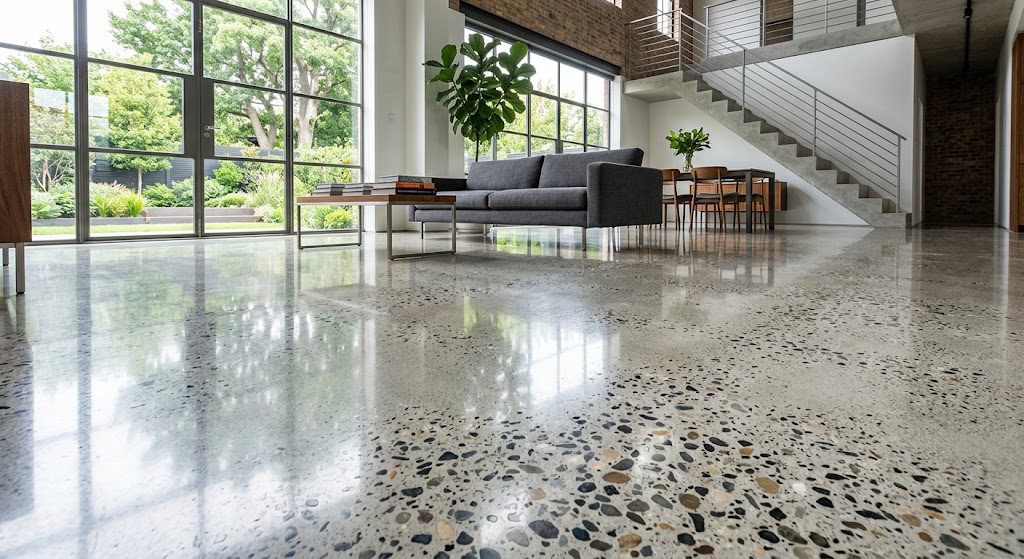
At first glance, polished concrete can look slippery because of its smooth, reflective finish. But appearance does not always tell the full story. For building owners, facility managers, and property developers, understanding how polished concrete performs under real-world conditions is essential before making a flooring decision that affects safety, maintenance costs, and long-term value.
Is Polished Concrete Slippery?
No, properly installed polished concrete is generally not slippery when clean and dry. In many cases, it offers slip resistance comparable to or better than other hard flooring materials such as marble, polished tile, or sealed hardwood. However, water, dust, oil, soap residue, and poor maintenance can temporarily reduce traction on any hard surface, including polished concrete.
Why Does Polished Concrete Look Slippery?
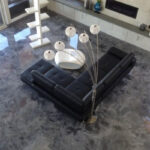
The most common assumption about polished concrete comes from a visual cue: shine equals slick. A high-gloss surface reflects overhead lighting and surrounding objects, which creates the illusion of a wet or glass-like surface. That reflection is purely optical.
The actual surface of polished concrete contains microscopic texture left behind by diamond abrasive grinding. Even a high-gloss polished floor retains thousands of tiny peaks and valleys at the microscopic level. These textures provide grip for footwear, even though the floor appears mirror-smooth to the eye.
In other words, gloss measures how the surface reflects light. Slip resistance measures how the surface interacts with friction. The two are not the same, and experienced concrete polishing contractors design floors with both performance values in mind.
Is Polished Concrete Slippery When Dry?
Properly polished concrete is not slippery under normal dry conditions. When tested against the ANSI B101.1 standard for walkway surfaces, most polished concrete floors fall within the high-traction category.
Performance in Normal Foot Traffic
Polished concrete performs reliably across many environments where dry foot traffic dominates the daily activity:
- Offices where employees and visitors walk in standard footwear
- Retail stores with consistent foot traffic and clean entry zones
- Warehouses with forklift wheels and rubber-soled work boots
- Showrooms where appearance and durability both matter
- Educational facilities with high traffic during peak hours
When the floor is clean, dry, and maintained according to a professional schedule, polished concrete typically meets or exceeds OSHA’s recommended static coefficient of friction of 0.50.
Is Polished Concrete Slippery When Wet?
This is where context matters. Polished concrete becomes more slippery when wet, but so does every other hard flooring material, including marble, ceramic tile, vinyl, and sealed hardwood.
What Happens When Water Hits the Surface?
Water reduces the friction between the shoe sole and the floor surface on virtually any flooring product. On polished concrete, several common conditions can lower traction temporarily:
- Rainwater tracked in from entrances during storms
- Cleaning water left behind during or after mopping
- Beverage spills in restaurants, cafeterias, and break rooms
- Snow and salt traffic in colder months along the Northeast
The important nuance for building owners is that polished concrete is not unusually slippery when wet. It performs comparably to other smooth, hard surfaces. The difference is in how the floor was finished and how consistently it is maintained.
7 Factors That Affect Polished Concrete Slip Resistance
This is the deeper insight most flooring articles overlook. Slip resistance on polished concrete is influenced by a combination of installation choices and ownership habits.
Gloss Level
A satin or hone finish typically offers slightly more traction than a high-polish mirror finish, though the difference is smaller than most assume.
Concrete Density
Densified concrete polished by experienced contractors creates a tighter, more consistent surface that holds slip-resistant treatments better.
Diamond Grinding Process
The progression of diamond grits, from aggressive metal bond grinding to fine resin polishing, determines the final microtexture that affects friction.
Surface Contamination
Dust, grease, oil, food residue, and soap film all reduce slip resistance until removed.
Cleaning Chemicals
Wrong cleaning chemicals leave behind residue that builds up over time and turns a safe floor into a slick one.
Traffic Patterns
High-traffic lanes wear differently from low-traffic corners, which can create uneven friction zones.
Maintenance Schedule
Floors maintained by professional concrete polishing services consistently outperform neglected floors in slip safety.
Understanding Slip Ratings and Floor Safety Standards
Building owners benefit from understanding the basic measurements used to rate floor safety.
- Coefficient of Friction (COF): A numerical value that measures how much resistance a surface provides against slipping. Higher numbers mean more grip.
- ANSI A326.3: The current American National Standards Institute test method for measuring dynamic coefficient of friction (DCOF) on hard surface flooring.
- OSHA Guidance: The Occupational Safety and Health Administration recommends a minimum static coefficient of friction of 0.50 for walking surfaces in commercial environments.
- Commercial Building Safety: Many polished concrete floors test at or above 0.50 DCOF when maintained properly.
A reputable concrete polisher can provide test results or specifications matched to the building’s intended use.
Where Polished Concrete Works Best?
Commercial Buildings
Lobbies, corporate offices, and government buildings benefit from polished concrete’s durability, low maintenance, and clean appearance.
Warehouses
Polished concrete handles forklift traffic, heavy loads, and pallet movement while remaining slip-rated for industrial use.
Retail Stores
Grocery chains, big-box retailers, and boutique shops use polished concrete for its visual appeal and long lifespan.
Medical Facilities
Hospitals and clinics rely on polished concrete because it resists bacteria buildup and supports strict cleaning protocols.
Residential Lofts
Modern homes and converted industrial spaces use polished concrete for its design flexibility and easy upkeep.
How Building Owners Can Improve Slip Resistance
According to NIOSH, there has been an increase in the slips, trips and falls statistics. However, there are some practical ownership steps that would help to reduce slip risk. Some of them are:
- Daily dust removal with microfiber pads to prevent grit buildup
- Prompt spill cleanup before liquids spread or dry into residue
- Anti-slip conditioners applied by a professional concrete polishing service
- Proper entry mats that capture water, snow, and debris before it reaches the polished surface
- Scheduled professional maintenance every 12 to 24 months depending on traffic volume
- Wet floor signage during cleaning cycles or after spills
These steps cost very little compared to the liability and replacement costs that come with a poorly maintained floor.
Why Does Professional Concrete Polishing Service Make a Difference?
At Old Stone Restoration & Installation Corp, we have spent 35+ years helping commercial, industrial, and residential property owners across Long Island and the tri-state area achieve safer, longer-lasting polished concrete floors. Proper grinding, densifying, and finishing techniques directly impact both appearance and slip resistance.
Experienced concrete polishing contractors use heavy-duty grinders weighing 700 to 1,100 pounds, progress through the correct diamond grit sequence, apply chemical densifiers correctly, and finish with sealers or conditioners suited to the building’s traffic and use. Cutting corners on any of these steps creates floors that look acceptable but underperform on safety, durability, and long-term cost.
Common Mistakes Property Owners Make
- Hiring inexperienced concrete polishing contractors who lack the right equipment or training
- Choosing shine over function without considering how the space is actually used
- Ignoring maintenance until the floor loses traction or develops staining
- Using wrong cleaners such as acidic or oil-based chemicals that strip the seal or leave residue
- Skipping moisture testing before installation, which leads to coating failure and surface inconsistency
Avoiding these mistakes starts with hiring a qualified concrete polisher who evaluates the slab before quoting the work.
Is Polished Concrete Right for Your Building?
| Space Type | Good Choice? | Notes |
| Retail | Yes | High durability, easy cleaning |
| Warehouse | Yes | Low maintenance, heavy load capable |
| Office | Yes | Professional appearance, long lifespan |
| Restaurant | Yes, with planning | Spill control and entry mats needed |
| Medical Facility | Yes | Sanitary, seamless surface |
| Pool Areas | Depends | Extra slip treatment required |
| Bathrooms | Depends | Surface texture and finish matter |
| Residential Loft | Yes | Modern look, durable finish |
Schedule a Free Polished Concrete Consultation Today
Polished concrete is one of the safest, most durable, and most cost-effective flooring solutions available when installed and maintained correctly. With 35+ years of experience serving Long Island and the tri-state area, Old Stone Restoration & Installation Corp delivers polished concrete floors built for safety, longevity, and lasting visual appeal.
Call (631) 821-5619 or email info@oldstonerestoration.com for a free on-site evaluation. Visit us to learn more about finish options, gloss levels, and the proven process behind every floor we install.
FAQs
Is polished concrete slippery for elderly people?
Properly finished polished concrete provides adequate traction for elderly residents when kept clean and dry. Adding anti-slip conditioners and entry mats further reduces risk in senior living environments.
Is polished concrete more slippery than tile?
No. Polished concrete is typically equal to or less slippery than polished ceramic and porcelain tile, particularly when both surfaces are dry. Grout lines on tile can create trip hazards that polished concrete does not have.
Can polished concrete be slip resistant?
Yes. With the correct finish level, professional installation, and anti-slip treatments, polished concrete meets ANSI and OSHA slip resistance standards for commercial and industrial use.
Does polished concrete get slippery after cleaning?
It can, if cleaning chemicals leave residue or if the floor is not dried after mopping. Using pH-neutral cleaners and proper drying methods prevents this issue.
How do you make polished concrete less slippery?
Apply a professional anti-slip conditioner, maintain a regular cleaning schedule with the correct chemicals, install quality entry mats, and schedule periodic professional maintenance with a qualified concrete polishing service.